
Ready to Move vs Under Construction: Which Is Better in 2026?
8 November 2026 · 12 min read
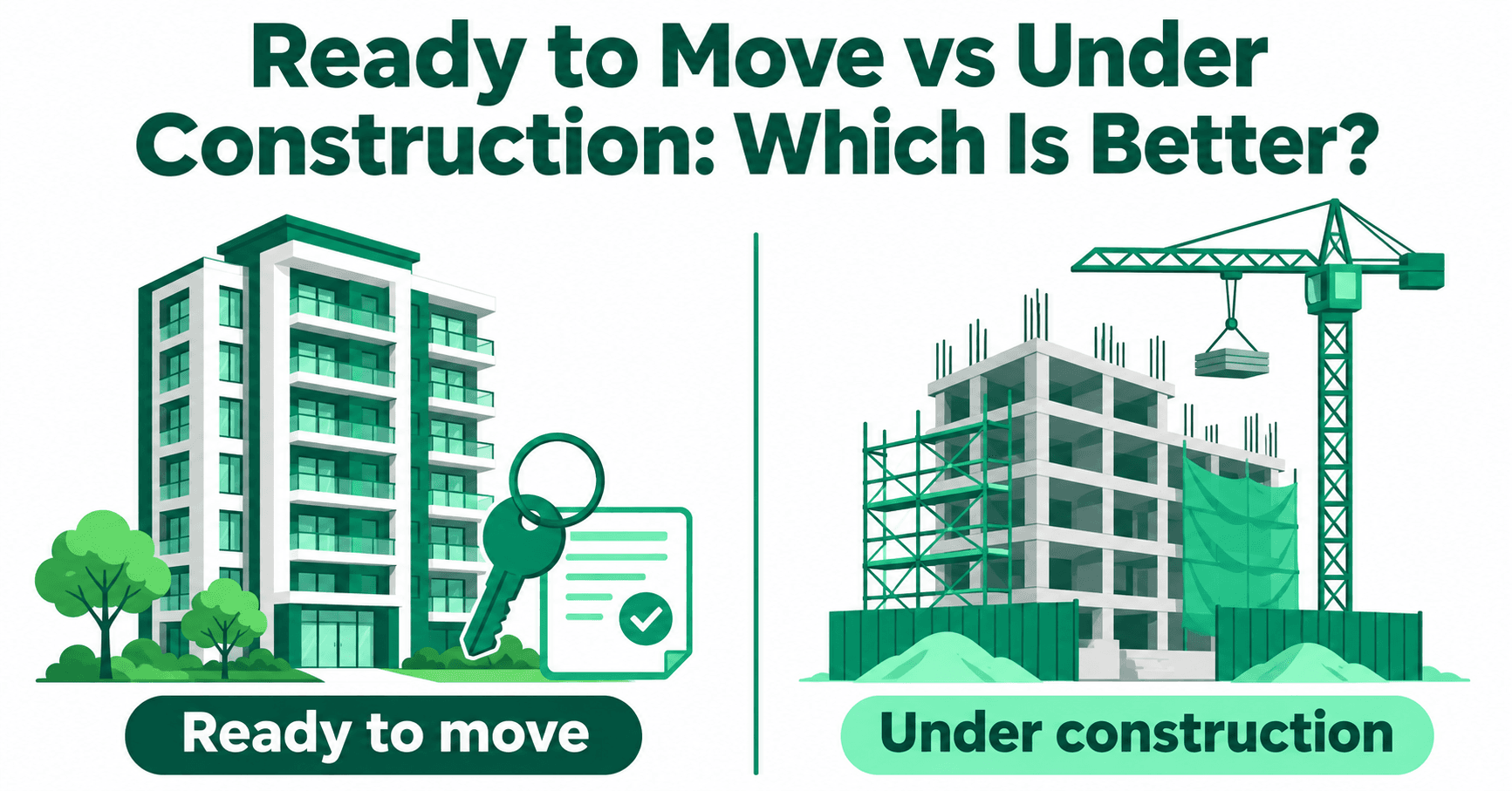
Ready to move vs under construction: it's the first big decision most home buyers in Pune face. Do you buy a flat that's finished and move in next month, or book one in a project that will be ready in two or three years, usually at a lower price? There's no answer that's right for everyone. But there is a right answer for you, and it comes down to a handful of things: when you need the home, whether you're paying rent now, how much risk you can live with, and how the costs really add up. This guide walks through each one.
Quick summary
- Ready to move: you see exactly what you're buying, move in or rent it out straight away, and pay no GST. It usually costs more per square foot.
- Under construction: a lower launch price and payments spread over the build, but 5% GST, rent and pre-EMI while you wait, and the risk of delay.
- Home loans differ: a ready flat's loan is paid out in full and the full EMI starts at once; an under-construction loan is paid out in stages, with interest-only pre-EMI until then.
- Rule of thumb: if you need the home within a year or already pay rent, ready-to-move usually wins once everything is added up.
What is a ready-to-move flat?
A ready-to-move flat is one in a building that's complete and has its Occupancy Certificate (OC), so you can take possession as soon as the paperwork is done. An under-construction flat is one you book from the builder before the building is finished, usually paying in stages as construction progresses. There's a grey area in between. A builder may call a flat "ready" when the building looks finished but the OC hasn't been issued yet. Legally, and for GST, that flat is still under construction. Always ask for the OC for your wing before you treat a flat as ready.
Check the OC for your wing before you treat a flat as ready.
How to Check an Occupancy CertificateReady to move vs under construction: side by side
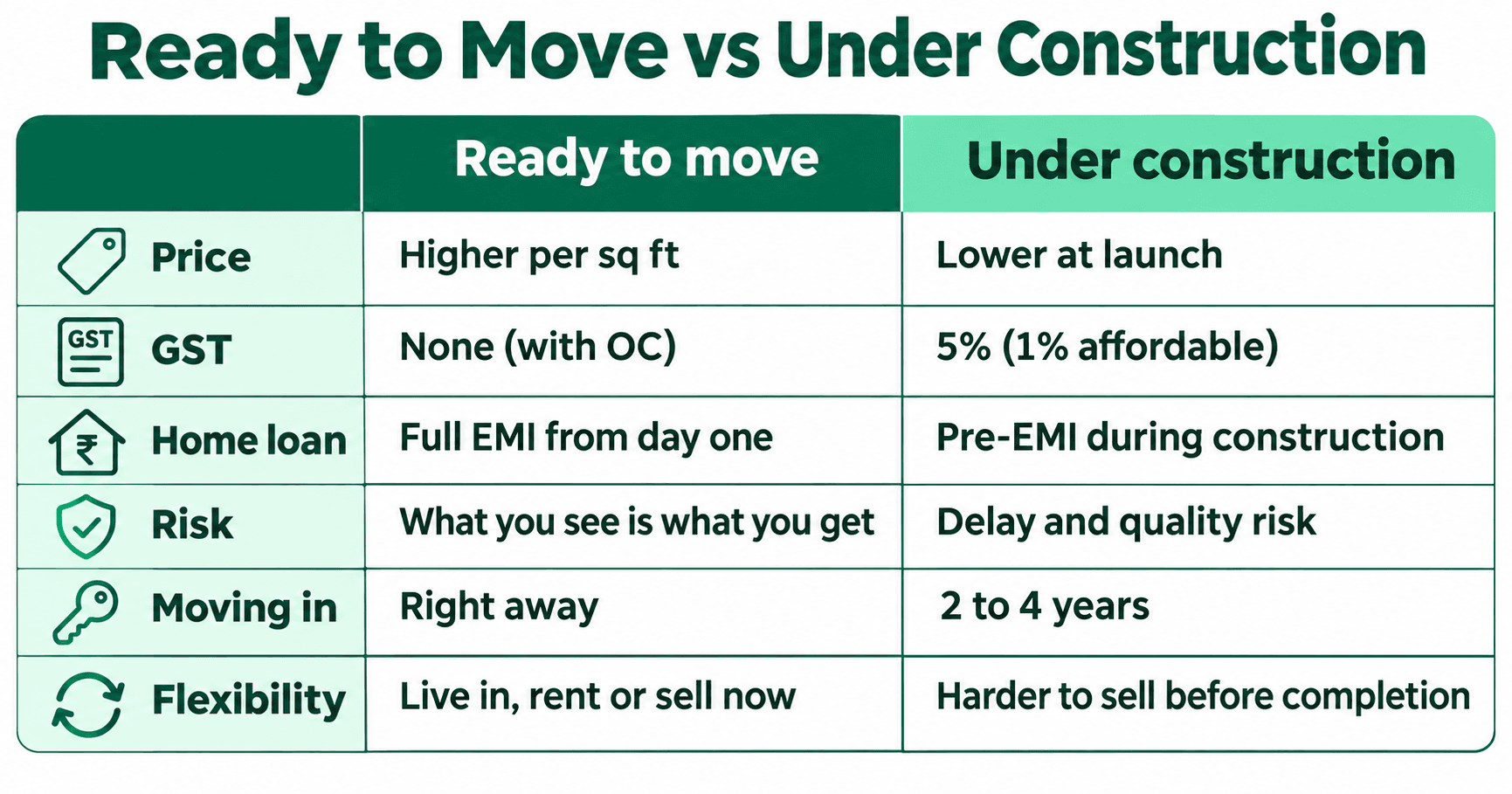
| Ready to move | Under construction | |
|---|---|---|
| Price | Usually higher per sq ft | Usually lower at launch |
| GST | None, with an Occupancy Certificate | 5% (1% for affordable homes) |
| Payments | Down payment, then the loan pays the rest | Spread over the build, linked to construction stages |
| Home loan | Paid out in full; full EMI from the first month | Paid out in stages; interest-only pre-EMI until then |
| Rent while you wait | None | Usually yes, for 2 to 4 years |
| Risk | What you see is what you get | Delays, changes and the builder's finances |
| Choice of flats | Limited to what's left | Wider choice of floor, view and layout |
| Selling before completion | Not applicable | Possible, but needs the builder's consent |
| Defect warranty | 5 years from the original handover | 5 years from handover |
Under construction or ready to move: the home loan difference
This is one of the most searched questions, and the difference is bigger than most people expect. With a ready-to-move flat, the bank pays the seller the full loan amount at registration. Your full EMI starts the next month, and every EMI reduces your principal from the start. With an under-construction flat, the bank pays the builder in stages as each part of the building is finished. Until the last payment, you usually pay only interest on the amount paid out so far. This is called pre-EMI. It feels light at first, but it doesn't reduce what you owe at all, and if the project is delayed, you keep paying it for longer, often alongside rent. Some builders offer subvention schemes where they pay the pre-EMI until possession. Read the fine print: if the builder stops paying, the bank will come to you. Tax works differently too. Interest paid before completion can't be claimed while you wait. Under the old tax regime, it's claimed in five equal parts from the year you get possession, within the usual limit, and the deduction for principal repayment only starts after possession. Under the new regime, neither applies to a home you live in.
Work out your EMI before you compare the two.
Home Loan CalculatorGST: 5% vs nothing
Under-construction flats carry 5% GST, or 1% if the flat counts as affordable housing (up to 90 sq m of carpet area and ₹45 lakh in Pune). Ready-to-move flats with an OC carry no GST at all. On an ₹80 lakh flat, that's ₹4 lakh. The catch is that if any part of the price, including a booking amount, is paid before the OC is issued, GST can apply to the whole price. Our guide to GST on ready-to-move flats explains how this works.
How the rule works, and the catch on money paid before the OC.
Why There's No GST on Ready-to-Move FlatsThe real cost of waiting
The launch price of an under-construction flat is often lower. But it's rarely the whole story. While you wait, you're usually paying rent and pre-EMI at the same time, plus GST on the flat itself. And if the project is delayed, those costs keep running. In our waiting-penalty example, an under-construction flat quoted at ₹75 lakh ended up costing about ₹91.85 lakh once 5% GST, 30 months of rent at ₹32,000 and a provision for delay were added, against ₹80 lakh for the same flat ready today. Put your own rent and timeline into the same sum before you decide.
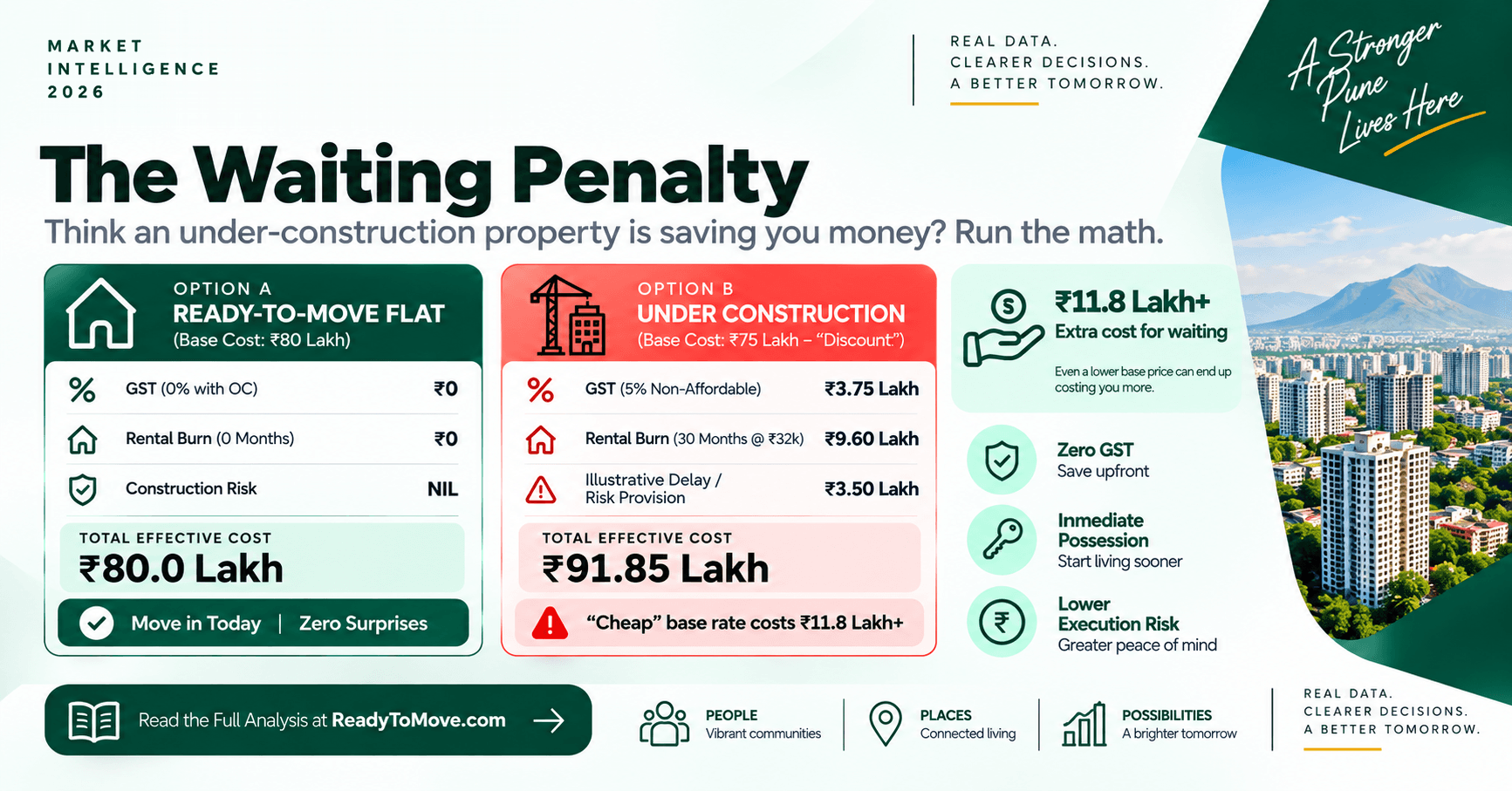
The sum behind these figures, and what the oversupply means for buyers.
See the Full Waiting-Penalty ExampleHow big is the delay risk?
Real, even with RERA. On 8 November 2026, MahaRERA's list of projects in abeyance because of a lapsed completion date included 1,051 in Pune district. These projects can't take new bookings or sign sale agreements until the builder files overdue updates or completion documents. That list changes all the time, so check any project you're considering on the MahaRERA website. If your project is delayed, RERA gives you rights: you can claim interest for every month of delay, or withdraw and get your money back with interest. But getting there can take months of hearings, and it doesn't stop you paying rent in the meantime.
Find a project's status and completion date in five minutes.
How to Check a Project on MahaRERAWhen does an under-construction flat make sense?
Under-construction isn't a bad choice. It can be the better one if:
- You don't need the home for three years or more, and you aren't paying rent now, for example if you live with family.
- The builder has a strong record of finishing projects on time, which you've checked on MahaRERA.
- You want a specific floor, view or layout that's no longer available in completed buildings.
- You'd rather pay in stages over a few years than make a larger payment now.
- You're comfortable with the risk, and you've added GST, rent and pre-EMI to the price before comparing.
When is ready to move the better choice?
- You need a home within a year.
- You're paying rent now. Every month of waiting is money you don't get back.
- You want to see the actual flat, the view, the water supply and how the society is run before you pay.
- Your job or plans could change. A finished flat can be rented out or sold straight away.
- You're buying from abroad and can't follow a construction site from another time zone.
Why more people in Pune's IT parks are skipping new launches.
Why IT Professionals Choose Ready-to-MoveIs it good to invest in under-construction property?
For an investor, the case for under-construction is that prices may rise between launch and completion. That can work in a rising market with a reliable builder. But the gain has to beat the 5% GST, the years without rent, and the risk that the project is delayed or the market goes flat. A ready flat starts earning rent from the first month, which is a return you can count on.
Can I sell an under-construction flat?
Yes, but not as freely as a finished one. You transfer your rights in the flat to the new buyer, which needs the builder's consent. Many builders charge a transfer fee, and the new buyer pays stamp duty on the transfer. MahaRERA's model agreement bars a transfer until all dues to the builder are paid, and some builders set their own conditions, such as a minimum share of the price. Check your agreement before you count on being able to sell early.
Buying an under-construction flat from an investor: the risks
Sometimes the flat you like isn't being sold by the builder, but by an investor who booked early and now wants out. The price can look attractive. But this isn't a normal resale. The building isn't finished, so the investor doesn't own a flat yet. What they hold is a right under their agreement with the builder, and that right is what you'd be buying. There are two ways this is done. In a transfer, the investor, you and the builder sign a document under which you take over the agreement and the remaining payments. In a cancel-and-rebook, the investor's agreement is cancelled and the builder signs a new one with you. Either way, nothing works without the builder. The risks to check:
- The builder can say no. MahaRERA's model agreement bars a buyer from transferring the flat until all dues to the builder are paid. Builders can change that wording, so read the investor's actual agreement.
- Transfer charges. Many builders charge a fee that can run into lakhs. Ask for the exact amount in writing, and agree who pays it.
- Your money goes to two places. You pay the investor for what they've paid plus any profit, and the builder for the remaining instalments. If the builder hasn't accepted you, the money paid to the investor is at risk.
- The investor's home loan. If they have one, their bank must be paid off first and must release its claim on the flat. Pay that bank directly.
- Your home loan isn't guaranteed. Banks usually want the builder's written consent and an agreement that includes the builder. Get your bank's approval in writing before you pay anything.
- Stamp duty. You'll pay stamp duty on the transfer or on a new agreement. Any credit for what the investor paid may be limited, so check the figure before you agree a price.
- GST and tax. Ask the builder in writing how GST on the remaining instalments will be handled, and ask a CA about TDS on what you pay the investor.
- Delays. The Supreme Court has said a later buyer can seek the same relief as the original buyer, but what you get depends on the facts. Your position is far weaker if the builder hasn't formally accepted you.
Before you pay even a token amount:
- Read the investor's registered agreement and its transfer clause.
- Get the builder's written consent, and a statement of what's been paid and what's due.
- Check the project on MahaRERA, including its status and completion date.
- Get a loan closure letter if the investor has a loan.
- Make the deal conditional on the builder's consent and your loan, with your money refundable if either fails.
- Pay only by bank transfer, and have a property lawyer check the papers.
If all this sounds like a lot, that's because it is. A finished flat with its Occupancy Certificate avoids most of it.
When to register an under-construction flat
Under RERA, a builder can't take more than 10% of the price before a written agreement for sale is registered. So the agreement should be registered, and stamp duty paid on it, at or before the point you pay more than 10%. Don't make larger payments on an unregistered allotment letter.
A simple way to decide
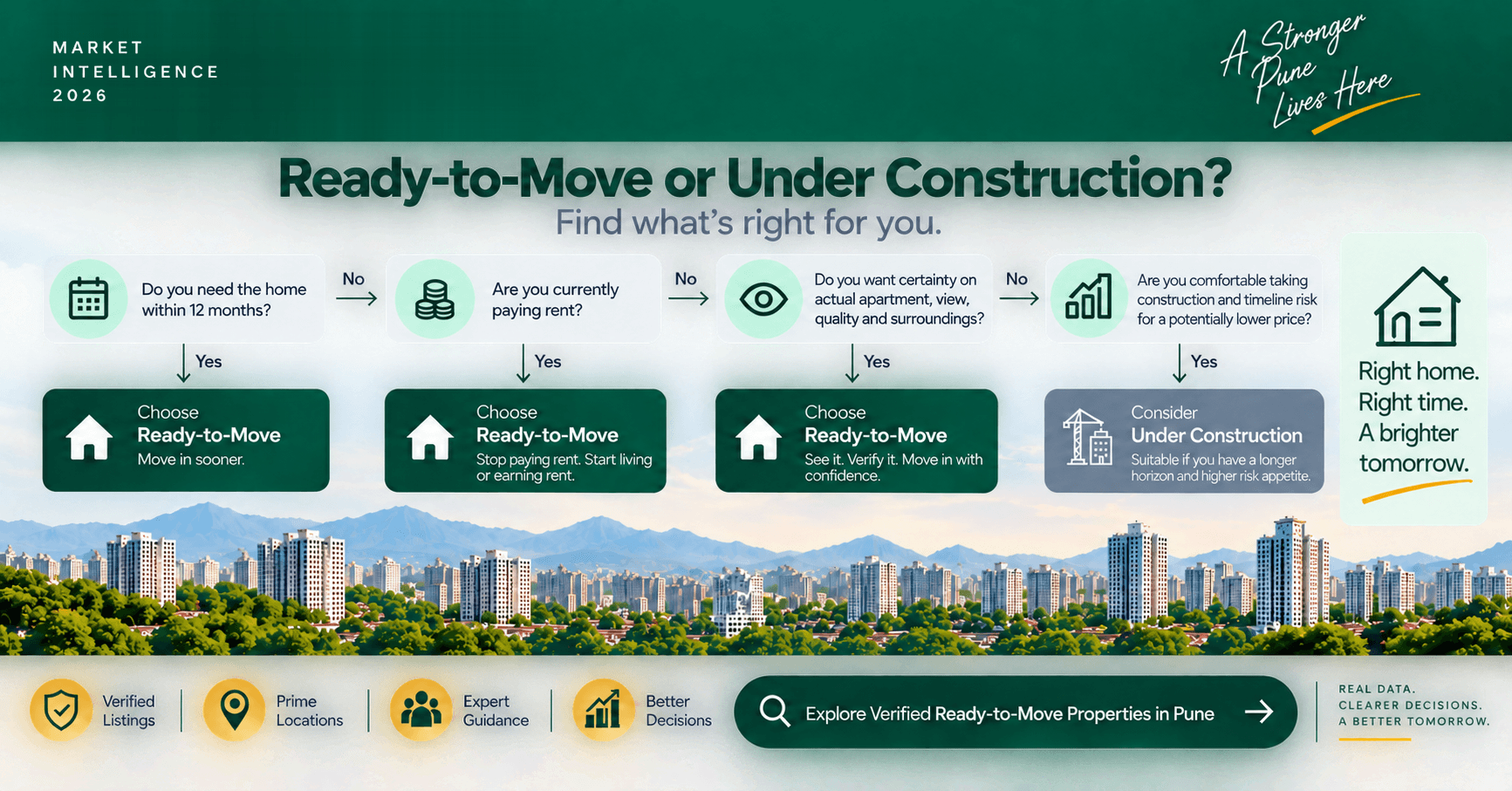
- Need the home within 12 months? Choose ready to move.
- Paying rent now? Add the rent and pre-EMI to the under-construction price. Ready to move usually wins.
- Want certainty about the actual flat, view and quality? Choose ready to move.
- None of these, a long horizon and a builder with a clean record? Under construction can work.
See ready-to-move flats in Pune
Every listing on ReadyToMove is a finished home with its Occupancy Certificate: no GST, no waiting and nothing left to chance. Browse our listings, or talk to our team and we'll compare a ready flat with an under-construction option for you, with every cost included.
Sources: Real Estate (Regulation and Development) Act, 2016: Sections 13 and 18 (India Code); FAQs on the real estate sector (GST rates) (GST Council); MahaRERA: Abeyance Project List (extracted 8 November 2026); MahaRERA (official website for project status and complaints); MahaRERA model agreement for sale (MahaRERA website); Laureate Buildwell v Charanjeet Singh, Supreme Court, 22 July 2021; Parsvnath Developers v Mohit Khirbat, Supreme Court, 20 February 2026; Buying a resale flat in an under-construction building when the seller has a loan (Propsoch).
Finished homes across Pune, each with its Occupancy Certificate.
Browse Ready-to-Move FlatsThis article is for general information and isn't financial, tax or legal advice.
We'll compare a ready flat with an under-construction option for you.
Talk to Our TeamFrequently asked questions
Which is better, ready to move or under construction?
It depends on your timeline and risk appetite. Ready-to-move flats cost more per square foot but have no GST, no waiting and no construction risk. Under-construction flats are cheaper at launch but carry 5% GST, rent and pre-EMI while you wait, and the risk of delay.
What is a ready-to-move flat?
A flat in a completed building that has its Occupancy Certificate, so you can take possession as soon as the sale is registered.
Is GST charged on ready-to-move flats?
No, if the building has its Occupancy Certificate and you pay after it's issued. Under-construction flats carry 5% GST, or 1% for affordable homes.
What is the home loan difference between under-construction and ready-to-move flats?
For a ready flat, the full loan is paid out at once and the full EMI starts immediately. For an under-construction flat, the loan is paid in stages and you pay interest-only pre-EMI until the last payment.
Can I sell an under-construction flat?
Yes, by transferring your rights to a new buyer with the builder's consent. Builders often charge a transfer fee, and MahaRERA's model agreement bars a transfer until all dues to the builder are paid, so check your agreement first.
Can I buy an under-construction flat from an investor?
Yes, but only with the builder's involvement. You either take over the investor's agreement through a transfer the builder signs, or the investor cancels and the builder signs a new agreement with you. Check the transfer clause first, because some agreements bar transfers until all dues are paid.
Can I get a home loan on an under-construction resale?
Sometimes, but don't assume it. Banks usually want the builder's written consent and an agreement that includes the builder. If the investor has a loan, it must be closed first. Get your bank's approval in writing before paying anything.
Does the builder have to agree to a transfer?
In practice, yes. Most agreements require the builder's consent, and we found no rule that forces a builder to give it.
When should an under-construction flat be registered?
Before you pay more than 10% of the price. RERA doesn't allow builders to take more than 10% without a registered agreement for sale.
Is it good to invest in under-construction property?
It can work in a rising market with a builder who delivers on time, but the gain has to beat 5% GST, years without rent and the risk of delay. A ready flat earns rent from the first month.
What happens if my under-construction flat is delayed?
Under RERA, you can claim interest for each month of delay or withdraw and get a refund with interest, by filing a complaint with MahaRERA.
Ready to find your next home?
Browse verified ready-to-move flats across Pune.