
Occupancy Certificate in Pune: How to Check It Before You Buy (Plus a Site-Visit Checklist)
12 October 2026 · 9 min read
Image is a mock-up for illustration purposes only.
"Ready to move" is printed on half the hoardings in Pune. Legally, though, a flat is ready to move into only when it has an Occupancy Certificate, usually called the OC. Without one, you can't legally live there, you may struggle to get a home loan or a permanent water and electricity connection, and you could end up paying higher property tax for years. This guide explains what an OC is, how it differs from a completion certificate, how to check it yourself online, and what to look for on a site visit before you pay a rupee.
Quick summary
- An OC is issued by the planning authority (PMC, PCMC or PMRDA in the Pune area) once a building is complete and safe to live in.
- Check it yourself on the project's MahaRERA page, and on the PMC, PCMC or PMRDA building permission portal. Then ask the builder for a copy.
- Part OC is common in big projects. It's valid, but only for the specific wings or floors it names. Make sure yours is one of them.
- No OC means no GST benefit, likely trouble with loans and utilities, and a flat you can't legally occupy.
- The Supreme Court has held that a builder's failure to get an OC is a deficiency in service, so buyers can claim compensation.
What is an Occupancy Certificate?
An Occupancy Certificate is the document that says a building has been built according to its approved plans and is fit to live in. The planning authority issues it after inspecting the building and checking that it meets the rules on structure, fire safety, water, drainage and lifts. In the Pune area, it's issued by whichever authority approved the building plan. That's the Pune Municipal Corporation (PMC) for most of the city, the Pimpri-Chinchwad Municipal Corporation (PCMC) for areas like Wakad, Pimple Saudagar and Ravet, and the Pune Metropolitan Region Development Authority (PMRDA) for many areas outside the two corporations, including Hinjewadi. Some plots inside industrial and IT parks are approved by MIDC instead. The easiest way to know which authority approved your building is to look at its commencement certificate, which names the issuing body.
OC vs completion certificate vs commencement certificate
These three get mixed up all the time, sometimes on purpose. Here's the difference:
| Certificate | When it's issued | What it tells you |
|---|---|---|
| Commencement Certificate (CC) | Before construction starts | The builder is allowed to start building to the approved plan. |
| Completion Certificate | When construction is finished | The building was completed as per the approved plan. On its own, it doesn't permit people to move in. |
| Occupancy Certificate (OC) | After the final inspection | The building is safe and fit to live in. This is the one that makes a flat legally "ready to move". |
Be careful when a builder tells you the completion certificate "is the same as the OC". The PMC has publicly said they are two different certificates.
What is a part OC, and is it safe?
Large Pune projects with several towers usually get their OC one building, or even one wing, at a time. This is called a part OC or partial OC. It's completely legal, and it's how most big townships hand over flats in phases. The catch is that it covers only the buildings, wings or floors written on it. If you're buying in Tower C and the part OC covers Towers A and B, your flat isn't ready to move, however finished it looks. Always read the OC itself and find your wing and floor on it. Also ask which amenities are covered. A clubhouse or pool that's still being built won't be.
How to check an Occupancy Certificate online
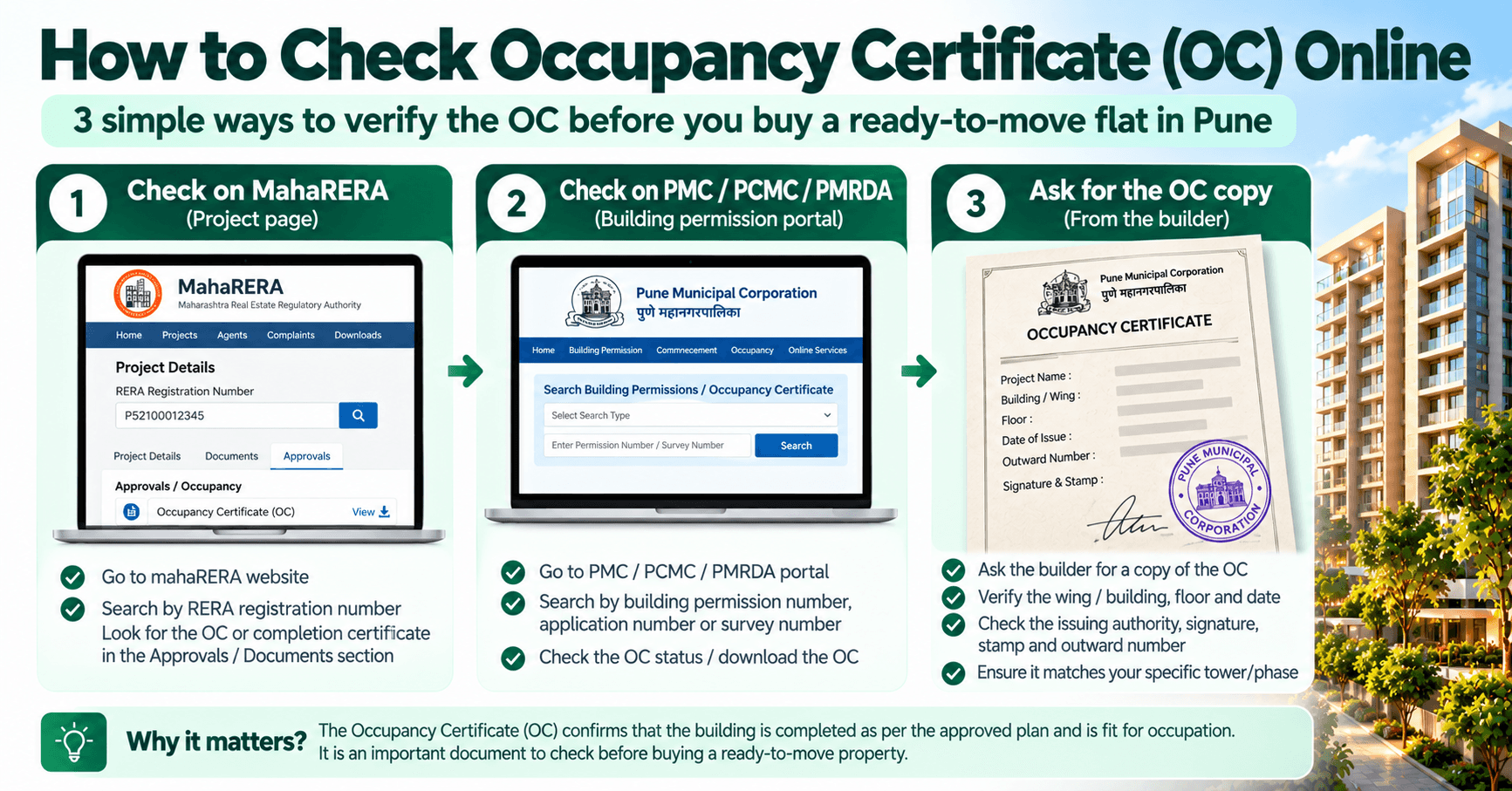
Image is a mock-up for illustration purposes only.
1. On MahaRERA. Every registered project has a public page on the MahaRERA website. Search by the project's registration number (it starts with P52100 for most Pune projects) or by the project name. On the project page, look in the documents section for the Occupancy Certificate or completion documents. Builders are expected to upload them once they're received. A warning sign: if the project's proposed completion date has passed and there's no OC or extension on the page, ask the builder why. 2. On the PMC, PCMC or PMRDA website. Building permissions in Maharashtra are now handled online through the state's Building Permission Management System (BPMS). Look for the building permission section on the website of the authority that approved the project: pmc.gov.in for PMC, pcmcindia.gov.in for PCMC, or pmrda.gov.in for PMRDA. You'll usually need the building permission number or the survey or CTS number of the plot, which you'll find on the commencement certificate or the sale agreement. If you can't find the record online, the authority's building permission office or the local ward office can confirm the OC status. 3. Ask for a copy, and read it. Whatever the websites show, ask the builder or seller for a copy of the OC itself. A genuine OC carries the authority's name, an outward or reference number, the date, the survey number, the building and wing names, the number of floors, and an authorised officer's signature and stamp. Check that the floors on the OC match the floors actually built. Extra floors added after the OC aren't covered by it. If anything doesn't add up, your bank's lawyer will check it as part of the loan process anyway, but it's much better to find out before you've paid a token amount.
What happens if you buy a flat without an OC?
- It isn't legal to live there. Municipal corporations can and do act. In January 2026, PMC's Hadapsar ward office served notice on a project over flats being occupied without a completion certificate or OC.
- Utilities and tax can cost more. Without an OC, societies often depend on temporary connections and tankers, and municipal bodies can charge higher property tax and water rates.
- Getting a home loan is hard. Most mainstream banks won't lend on a flat that's supposed to be complete but has no OC, or they'll hold back the money until it's issued.
- You'll pay GST. A flat without an OC is treated as under construction, so 5% GST applies. On an ₹80 lakh flat that's ₹4 lakh.
- Reselling is harder. Future buyers and their banks will ask for the OC too.
If you've already taken possession without an OC, you aren't stuck. In Samruddhi Co-operative Housing Society vs Mumbai Mahalaxmi Construction (January 2022), the Supreme Court held that a builder's failure to obtain an OC is a deficiency in service under consumer law, and that flat owners can claim compensation for the extra taxes and charges it caused. You can also file a complaint with MahaRERA.
This is general information, not legal advice. For a specific case, please speak to a property lawyer.
Site-visit checklist for a ready-to-move flat
Once the paperwork checks out, go and see the flat itself. Take this list with you, and go at least once in the evening and, if you can, once after rain.
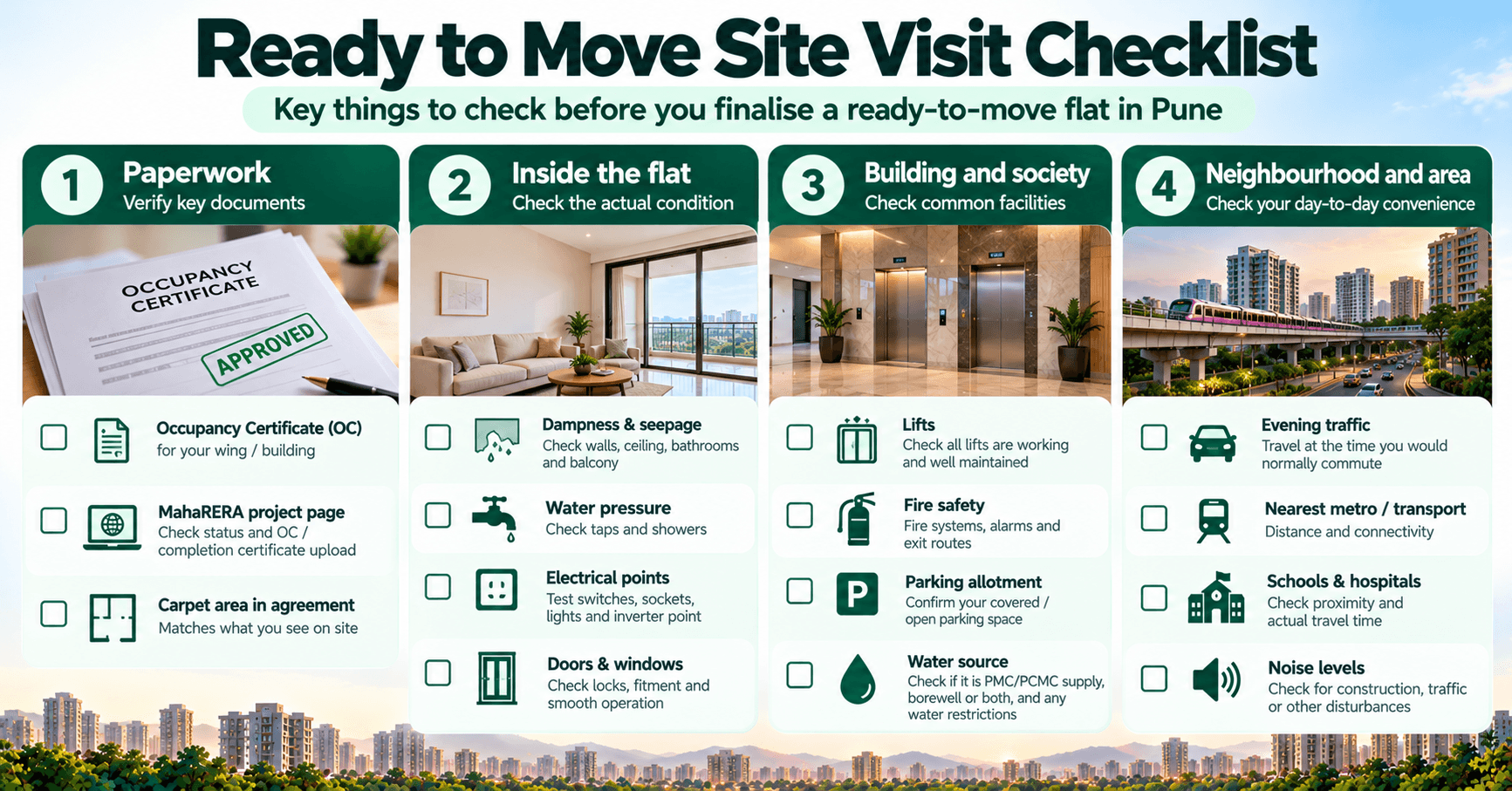
Image is a mock-up for illustration purposes only.
Paperwork to see on the spot:
- The OC, with your wing and floor on it.
- The MahaRERA registration certificate and the RERA carpet area of your flat.
- The draft agreement for sale, with your parking slot number written in.
- The society registration or the builder's timeline for forming the society.
Inside the flat:
- Damp patches, seepage or fresh paint in odd places, especially on walls next to bathrooms and on the ceiling of the top floor.
- Water pressure in every tap and shower, and how quickly the hot water comes through.
- Every switch, socket and light. Take a phone charger to test sockets.
- Doors and windows that close properly, and window grills or safety rails where you need them.
- Floor tiles that sound hollow when you tap them, and the slope of bathroom floors towards the drain.
- Measure the main rooms roughly and compare them with the plan. Big differences are worth asking about.
The building and society:
- Where the water comes from. Ask whether the society relies on municipal supply, a borewell or tankers, and what it costs each month. This matters a lot in parts of Hinjewadi and Wakad.
- Lifts that work, with a valid lift licence, and power backup for lifts and common areas.
- Fire extinguishers, hydrants and clear fire exits.
- Your allotted parking spot, not just "parking available".
- Maintenance charges, the corpus or sinking fund deposit, and what's included.
- Which amenities are finished and which are still "coming soon".
The neighbourhood:
- Your commute at peak time. Drive or ride it on a weekday morning before you decide.
- Walking distance to the nearest metro station, bus stop, school, hospital and supermarket.
- Noise from highways, flyovers or a metro viaduct, and any open land next door that could be built on.
- Street lighting and how the area feels after dark.
Write down anything that needs fixing and get it into a snag list signed by the builder before you take the keys. Under RERA, the builder must fix structural defects and poor workmanship reported within five years of possession, free of charge.
Every ReadyToMove listing is checked for its OC
We only list completed homes, and we check the Occupancy Certificate for each one before it goes live. Browse our current listings across Pune, or talk to our team if you'd like help checking a flat you've found elsewhere.
Completed homes with their Occupancy Certificate checked.
Browse Ready-to-Move FlatsFrequently asked questions
What is an Occupancy Certificate (OC)?
It's a certificate from the planning authority confirming that a building has been built according to its approved plans and is safe to live in. In Pune, it's issued by PMC, PCMC or PMRDA, depending on where the building is.
How do I check if a flat has an OC in Pune?
Look up the project on the MahaRERA website using its registration number and check the documents section. You can also check the PMC, PCMC or PMRDA building permission portal using the permission or survey number. Then ask the builder or seller for a copy of the OC and find your wing and floor on it.
Is a completion certificate the same as an OC?
No. A completion certificate says the building was finished as per its plan. The OC says it's fit to live in. You need the OC to legally occupy the flat.
Is it legal to buy a flat without an OC?
Buying isn't illegal, but living in a flat without an OC is not allowed, and municipal bodies can take action. You'll also face problems with home loans, utilities, property tax and resale, and you'll pay GST as if it were under construction.
What is a part OC?
A part or partial OC covers only some buildings, wings or floors of a project. It's legal and common in large projects. Make sure the part OC specifically names the wing and floor of the flat you're buying.
Can I get a home loan for a flat without an OC?
For a flat that's meant to be complete, most mainstream banks won't lend without an OC, or will hold back the money until it's issued. Under-construction flats are financed differently, in stages, against the builder's approvals.
Is GST payable on a flat with an OC?
No. Once a flat has its OC, GST doesn't apply. Under-construction flats and flats without an OC carry 5% GST, or 1% for affordable housing.
What can I do if my builder hasn't obtained the OC?
You can complain to MahaRERA and, if needed, file a consumer complaint. The Supreme Court held in 2022 that a builder's failure to get an OC is a deficiency in service, and buyers can claim compensation for the extra charges it causes. A property lawyer can advise on your case.
How long does it take to get an OC after construction?
It varies with the authority and how complete the paperwork is, but builders often apply a few months before handing over. Delays usually come from pending fire, water or drainage approvals.
What should I check during a site visit for a ready-to-move flat?
Check the OC for your wing, the carpet area in the agreement, damp or seepage, water pressure, electrical points, lifts, fire safety, your allotted parking and where the society's water comes from. Visit at peak commute time and in the evening too.
Ready to find your next home?
Browse verified ready-to-move flats across Pune.