
Society Transfer Charges in Pune: Who Pays and How Much Can a Society Charge?
9 November 2026 · 7 min read

Illustrative image.
When you buy a resale flat in Pune, the sale deed isn't the last step. You also need the housing society to transfer the membership and share certificate into your name, and the society will ask for transfer charges. This is where a lot of buyers and sellers get stuck. Some societies ask for far more than the law allows, or call it a "donation" or "development fund". Here's what a society can actually charge, who usually pays, and what to do if the demand doesn't add up.
Quick summary
- Transfer premium: a co-operative housing society in PMC or PCMC limits can charge at most ₹25,000 per flat.
- Transfer fee: ₹500 for transferring the share certificate, under the model bye-laws.
- Who pays: the law caps the amount but doesn't say who pays. It's agreed between buyer and seller; write it into the sale agreement.
- Family transfers: no transfer premium when a flat passes to a family member or heir.
- Not allowed: "donations", "development funds" or any other charge as a condition of the transfer.
What are society transfer charges?
In a co-operative housing society, you don't just own the flat: you're also a member of the society and hold its shares. When a flat is sold, the seller's membership and shares have to move to the buyer. The society charges for this. There are two parts:
- Transfer premium. The main charge, paid to the society when membership changes hands. This is what people usually mean by society transfer charges.
- Transfer fee. A small fee for transferring the share certificate into the buyer's name.
People also search for "society name transfer charges". It's the same thing: the charges for getting the flat into your name in the society's records.
How much can a society charge in Pune?
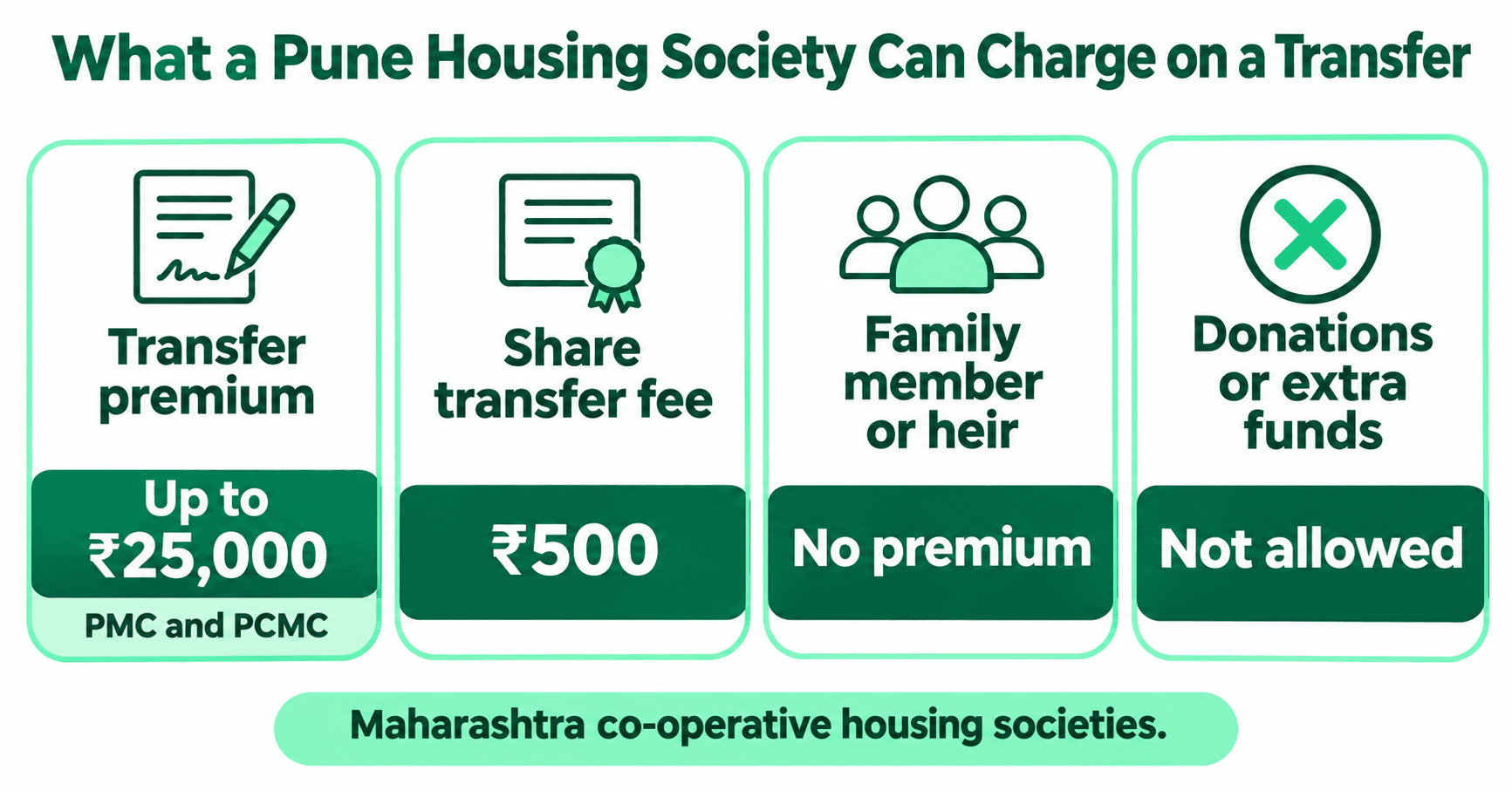
| Charge | Maximum | Notes |
|---|---|---|
| Transfer premium | ₹25,000 | In municipal corporation areas, including PMC and PCMC |
| Share transfer fee | ₹500 | Under the model bye-laws |
| Transfer to a family member or heir | No premium | Only the small transfer fee |
| Donations, development or other funds | Not allowed | Can't be made a condition of the transfer |
The ₹25,000 limit comes from a Maharashtra government order of August 2001, which fixed the maximum transfer premium a co-operative housing society can charge per flat in municipal corporation areas. Societies outside municipal corporations have lower limits. A society can charge less than the maximum, but not more. Societies have tried to get around the cap by asking for a “welfare fund”, “donation” or “development charge” on top. Courts have repeatedly ruled against this. In 2025, in Tirthankar Darshan Co-operative Housing Society v. State of Maharashtra, the Bombay High Court called such a “welfare fee” a camouflage for collecting more than the government allows.
Who pays society transfer charges: buyer or seller?
This is the question people search for most, and the honest answer is that the law doesn't fix it. The rules cap how much the society can charge, not who pays it. Strictly, the transfer is the seller's membership moving out and the buyer's coming in, so the seller applies for it. In practice in Pune, buyer and seller agree who pays as part of the deal. Sometimes the seller pays, sometimes the buyer, and sometimes they split it. Whatever you agree, write it into the agreement for sale, along with who will pay any pending maintenance or other dues. That avoids an argument at the end, when the society asks for the money.
Society transfer charges in blood relation or by gift deed
If a flat passes to a family member, whether through inheritance, a nomination or a gift to a close relative, the society can't charge a transfer premium. Only the small transfer fee applies. Who counts as family is set by the society's bye-laws. Spouses, children, parents and siblings are normally covered. More distant relatives, such as a nephew or a cousin, may not be, unless the bye-laws say so. If you're gifting a flat, check the society's registered bye-laws first.
What is a society NOC, and is it required to sell a flat?
A society NOC (no-objection certificate) is a letter from the housing society saying it has no objection to the sale. Buyers, and especially banks lending on a resale flat, often ask for one. Is it legally required? Generally, no. Courts have held that a society's NOC isn't a legal condition for a member to sell a flat in a co-operative housing society. The seller does need to tell the society about the sale, and the buyer will need the society to admit them as a member and transfer the shares. In practice, though, you'll want one. Most banks won't lend on a resale flat without it, and it usually comes with confirmation that there are no pending dues.
Can a housing society refuse an NOC or a transfer?
Not without a valid reason. A society can't refuse a transfer, or hold out for more money, just because it wants to. Valid reasons are things like unpaid dues on the flat. Courts have held that a buyer can't become a member until the previous owner's maintenance dues are cleared, which is why the no-dues certificate matters so much. If a society refuses without a good reason, or demands more than the law allows, the member can approach the Deputy Registrar of Co-operative Societies for their area, or the co-operative court in a dispute.
Step by step: transferring a resale flat in the society
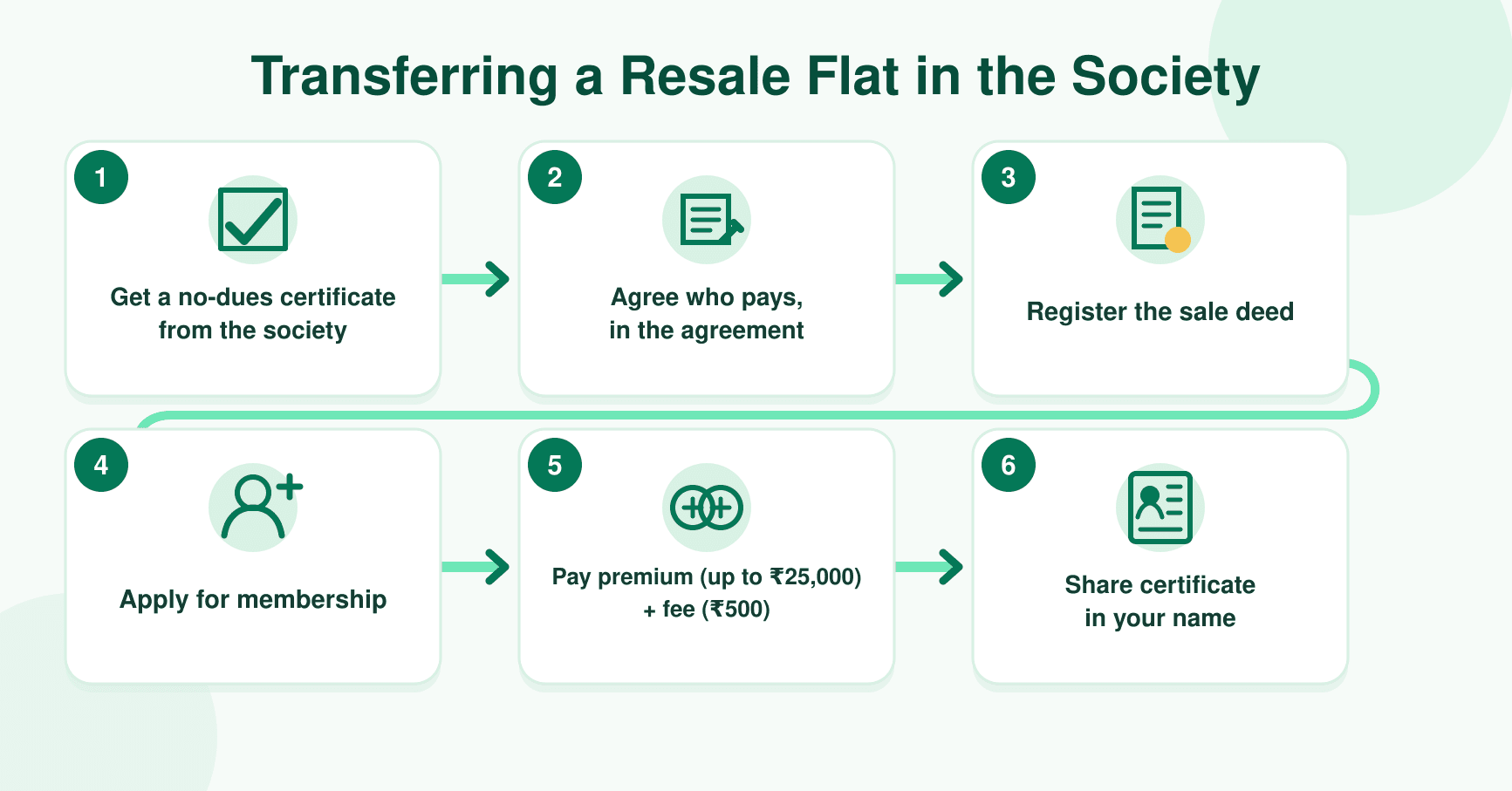
- Before you sign, ask the seller for a no-dues certificate from the society covering maintenance and other charges.
- Agree who pays the transfer premium and fee, and write it into the agreement for sale.
- Register the sale deed and pay stamp duty.
- Apply to the society for membership, with the registered sale deed, the original share certificate and the society's application forms.
- Pay the transfer premium (up to ₹25,000) and the transfer fee (₹500).
- The society transfers the share certificate into your name and records you as a member. Keep the endorsed share certificate safe.
What you'll pay when you register the sale deed.
Stamp Duty and Registration Charges in PuneWhat if your society asks for more than ₹25,000?
- Ask for the demand in writing, with a breakdown of each charge.
- Point to the ₹25,000 limit for the premium and the ₹500 transfer fee, and ask under which bye-law any other amount is charged.
- Pay the lawful amount and ask for a receipt that says what it's for.
- If the society won't process the transfer, write to the Deputy Registrar of Co-operative Societies for your area. A lawyer can help if it goes further.
How the full costs compare, including transfer charges.
Resale Flat vs New FlatBuying a resale flat in Pune?
We list resale and new ready-to-move flats across Pune, every one with its Occupancy Certificate, and we'll help you check the society's dues and transfer charges before you sign. Browse our listings, or read our guide to buying a resale flat in Pune.
Sources: Housing Manual, Co-operation Department, Government of Maharashtra (sahakarayukta.maharashtra.gov.in); Model bye-laws of co-operative housing societies in Maharashtra (TaxGuru); Society transfer charges rules (NoBroker); Flat transfer premium charges in co-operative housing societies (Surve); Auction purchaser must clear past maintenance dues for society membership: Bombay High Court (SCC Online, July 2026).
The steps, checks and costs of buying resale in Pune.
Our Guide to Buying a Resale FlatThis article is for general information and isn't legal advice. Bye-laws differ between societies. Please speak to a property lawyer about your transfer.
Resale and new homes across Pune, each with its Occupancy Certificate.
Browse Ready-to-Move FlatsFrequently asked questions
Who pays society transfer charges, buyer or seller?
The law doesn't say. It caps the amount but leaves it to buyer and seller to agree. In Pune it's commonly settled as part of the deal; write what you agree into your sale agreement.
How much are society transfer charges in Pune?
A co-operative housing society in PMC or PCMC limits can charge a transfer premium of up to ₹25,000 per flat, plus a ₹500 share transfer fee.
What are society transfer charges?
The premium and fee a co-operative housing society charges to move a flat's membership and shares from the seller to the buyer.
Are society transfer charges payable for a transfer in blood relation?
No transfer premium applies when a flat passes to a family member or heir; only the small transfer fee. Check the society's bye-laws for who counts as family.
Are transfer charges payable on a gift deed?
If the flat is gifted to a family member covered by the bye-laws, there's no transfer premium, just the transfer fee. Gifts to more distant relatives may be treated differently.
Is a society NOC required for the sale of a flat?
Generally not as a legal condition, but most banks ask for one before lending on a resale flat, and it's useful proof that there are no pending dues.
Can a housing society refuse an NOC?
Not without a valid reason such as unpaid dues. If a society refuses without reason or demands more than the law allows, you can approach the Deputy Registrar of Co-operative Societies.
Can a society charge a donation or development fund on a transfer?
No. Charges beyond the capped premium and the transfer fee can't be made a condition of the transfer, and courts have ruled against such demands.
Ready to find your next home?
Browse verified ready-to-move flats across Pune.