
NRI Guide to Buying Property in Pune: 2026 Rules, Home Loans, Tax and Repatriation
8 November 2026 · 10 min read

Pune is one of the most popular cities for NRIs buying a home in India. Many grew up here or studied here, the IT corridors give flats strong rental demand, and prices are still well below Mumbai or Bengaluru for similar homes. Buying from abroad does add a few extra steps: which account to pay from, how to sign documents when you aren't in India, how tax works on rent and sale, and how to get money back out later. This guide walks through each one, including two rule changes in 2026 that most older guides don't cover yet.
Quick summary
- NRIs and OCI cardholders can buy any number of residential or commercial properties in India without RBI approval. Agricultural land, plantations and farmhouses are off-limits, except by inheritance.
- Pay through banking channels only: an NRE, NRO or FCNR account, or money sent from abroad. Never in cash or foreign currency notes.
- NRI home loans are available from most Indian banks, with EMIs paid from your NRE or NRO account.
- Can't travel? A power of attorney given to someone in India lets them handle registration for you.
- New in 2026: the Income-tax Act, 2025 applies from 1 April 2026, and from 1 October 2026, resident individuals buying from an NRI can deduct TDS using their PAN instead of getting a TAN.
Can NRIs buy property in India?
Yes. Under the Foreign Exchange Management Act (FEMA), Non-Resident Indians (NRIs) and Overseas Citizens of India (OCI cardholders) can buy residential and commercial property in India without any permission from the RBI. There's no limit on how many properties you can buy. The only things you can't buy are agricultural land, plantation property and farmhouses. You can still inherit them, though. Foreign nationals who aren't of Indian origin generally can't buy property in India, except in limited cases such as when they're resident here.
How to pay for a property as an NRI
All payments must go through Indian banking channels. You can pay from:
| Account or route | What it is | Good to know |
|---|---|---|
| NRE account | Holds money you've earned abroad, in rupees | Tax-free interest, and the money is freely repatriable. Paying from here makes it easier to send sale proceeds back later. |
| FCNR account | A fixed deposit held in foreign currency | Also fully repatriable. |
| NRO account | Holds money earned in India, like rent or dividends | Repatriation is limited to USD 1 million a financial year, after tax. |
| Direct remittance from abroad | Money sent straight to the seller or builder through a bank | Keep the remittance certificate (FIRC) safe. |
Never pay in cash, and don't pay with traveller's cheques or foreign currency notes. Keep a record of every payment, as you'll need it for your home loan, your tax returns and any future repatriation.
Getting a home loan as an NRI
Most Indian banks and housing finance companies offer home loans to NRIs. The process is similar to a resident's loan, with a few differences:
- Loan amount: the same RBI limits apply as for residents: up to 90% of the property's value for loans up to ₹30 lakh, 80% up to ₹75 lakh and 75% above that. Some lenders are more conservative with NRIs.
- Income proof: your overseas salary slips, employment contract, bank statements and, in many cases, a credit report from the country where you work.
- Repayment: EMIs must be paid from your NRE or NRO account, or by remittance from abroad.
- Tenure: up to 30 years at lenders such as SBI and ICICI Bank, and 15 to 20 years at some others, usually ending by the time you turn 60 to 70.
- Rates: NRI home loan rates are often slightly higher than resident rates. Compare a few lenders.
Buying without travelling: power of attorney

If you can't come to Pune for the registration, you can give a power of attorney (PoA) to a family member or someone you trust in India. A specific PoA, limited to buying one named property, is safer than a general one.
- Draft the PoA naming the specific property and the actions the holder can take.
- Sign it in front of an Indian embassy or consulate officer abroad, or have it notarised and apostilled in the country you live in.
- Once it reaches India, it must be stamped (adjudicated) by the Collector of Stamps within three months of first arriving in the country, or it can't be used. Adjudication usually takes from a few days to about two weeks.
- Your PoA holder can then sign documents and attend registration on your behalf.
Some steps, like biometric registration, may still need the buyer in person depending on the sub-registrar's process. Ask your lawyer or builder to confirm before you plan your trip.
Why ready-to-move suits NRIs
Buying an under-construction flat from abroad means trusting progress photos and builder updates for years. Many NRIs have been burned by delays they couldn't follow up on in person. A ready-to-move flat with an Occupancy Certificate removes most of that risk.
- You (or someone you trust) can inspect the actual flat before you pay.
- There's no GST on a flat with an OC.
- You can rent it out straight away and start earning, instead of waiting three years.
- There are no construction-stage payments to keep track of from another time zone.
What to look for, and how to check it online before you pay.
How to Check an Occupancy CertificateTax on rental income
Rent you earn from a flat in India is taxable in India. Your tenant must deduct tax at source (TDS) on rent paid to an NRI under Section 393(2) of the Income-tax Act, 2025 (the old Section 195), at 30% plus surcharge and 4% cess, which is 31.2% before any surcharge. There's no minimum threshold, and the tenant needs a TAN. You can apply for a lower deduction certificate in Form 128, and claim back any excess by filing an Indian tax return. You can deduct 30% of the rent as a standard deduction for repairs, and the interest on your home loan, from the rental income. Rent is credited to your NRO account.
Selling later: TDS and capital gains
When an NRI sells property in India, the buyer must deduct tax at source from the full sale price, not just the profit, whatever the price. The ₹50 lakh threshold only applies when the seller is a resident. For property held more than two years, the rate is 12.5% on long-term capital gains plus surcharge and cess. For property held two years or less, it's charged at the slab rate, effectively 30% plus surcharge and cess. Because TDS is on the full price, it can be much higher than the tax you actually owe. To avoid that, apply for a lower or nil deduction certificate before the sale. Under the new Act, this application is made in Form 128, which replaced the old Form 13.
What changed on 1 October 2026
Earlier, anyone buying a property from an NRI had to get a TAN (Tax Deduction Account Number) just to deposit the TDS. From 1 October 2026, resident individuals and HUFs buying from an NRI can use their PAN instead. Companies, firms and LLPs still need a TAN. This makes selling to individual buyers simpler for NRIs.
Taking money back abroad (repatriation)
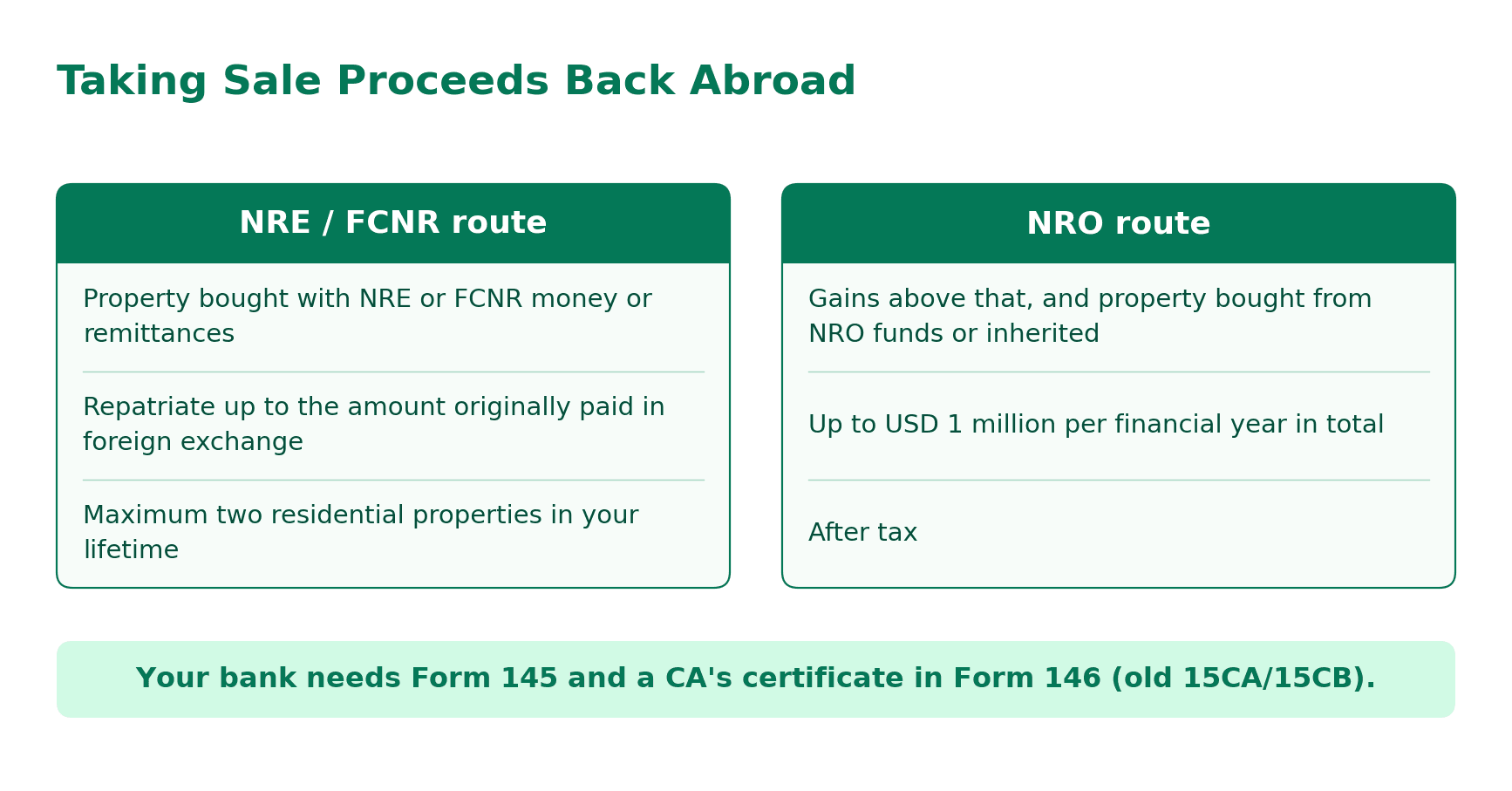
- Sale proceeds of property bought with NRE or FCNR money, or remittances from abroad, can be sent back abroad up to the amount you originally paid in foreign exchange. This is allowed for a maximum of two residential properties in your lifetime.
- Any gain above that amount, and the proceeds of property bought from NRO funds or inherited, goes through your NRO account, where the limit is USD 1 million per financial year in total, after tax. The two limits cover different money, so they apply separately.
- You'll need Form 145 and a CA's certificate in Form 146 for your bank to process the transfer. These replaced the old Forms 15CA and 15CB from 1 April 2026.
NRI property checklist
- Check that the project is registered on MahaRERA and the flat has its Occupancy Certificate.
- Pay only through your NRE, NRO or FCNR account, or direct remittance, and keep every receipt.
- Get a home loan pre-approval before choosing a flat.
- Give a specific power of attorney if you can't attend registration.
- Ask a local lawyer to check the title and the society documents.
- Plan who will look after the flat, find tenants and handle maintenance while you're abroad.
- File an Indian tax return each year you earn rent or sell property in India.
The same rates apply to NRIs. See what you'll pay on your flat.
Stamp Duty and Registration Charges in PuneBuy a ready-to-move flat in Pune from anywhere
We work with NRI buyers who can't visit often. Every listing on ReadyToMove is a completed home with its Occupancy Certificate, and our team can arrange video walkthroughs, coordinate site visits with your family in Pune, and connect you with lenders and lawyers who handle NRI purchases. Browse our listings or talk to our team.
Sources: FEMA rules for NRI property purchase in India (2026 guide) (Legiscore); TDS on NRI property sale: PAN replaces TAN from 1 October 2026 (Vakilsearch); NRI property rules India 2026: Form 128 TDS shift (NRI Affairs); NRI property sale 2026: FEMA, banking and repatriation (Whytecroft Ford); Income-tax Act, 2025 (Wikipedia).
Completed homes across Pune, each with its Occupancy Certificate.
Browse Ready-to-Move FlatsThis article is for general information and isn't legal or tax advice. Rules for NRIs change often. Please speak to a chartered accountant and a property lawyer before you buy or sell.
Tell us what you're looking for and where you are.
Talk to Our TeamFrequently asked questions
Can an NRI buy property in India?
Yes. NRIs and OCI cardholders can buy any number of residential or commercial properties in India without RBI approval. They can't buy agricultural land, plantations or farmhouses, but can inherit them.
Can an OCI cardholder buy a flat in Pune?
Yes. OCI cardholders have the same rights as NRIs to buy residential and commercial property in India.
Can NRIs get a home loan in India?
Yes. Most Indian banks and housing finance companies offer NRI home loans. You'll need overseas income proof, and EMIs must be paid from an NRE or NRO account or by remittance from abroad.
Which account should an NRI use to buy property?
An NRE or FCNR account, or direct remittance from abroad, is usually best, because it makes the sale proceeds easier to repatriate later. You can also pay from an NRO account.
Can an NRI buy property without visiting India?
Usually yes, through a specific power of attorney given to someone in India. The PoA is signed at an Indian embassy or consulate, or notarised and apostilled abroad, and then stamped in India.
What is the TDS when buying property from an NRI?
The buyer must deduct TDS on the full sale price: 12.5% plus surcharge and cess for long-term gains, or the slab rate for short-term gains. From 1 October 2026, resident individual buyers can use their PAN instead of a TAN to deposit it.
How is rental income taxed for NRIs?
Rent from Indian property is taxable in India. Tenants must deduct TDS, usually at 30% plus surcharge and cess. NRIs can deduct 30% for repairs and their home loan interest, and file a return to claim back any excess.
Can NRIs repatriate the sale proceeds of property?
Yes. If the property was bought with NRE, FCNR or foreign remittance, proceeds up to the amount originally paid can be repatriated, for up to two residential properties. Other amounts can be sent from an NRO account up to USD 1 million per financial year, after tax.
Do NRIs pay higher stamp duty in Pune?
No. Stamp duty and registration charges are the same for NRIs and residents: about 7% (6% for women) plus a ₹30,000 registration fee in Pune.
Ready to find your next home?
Browse verified ready-to-move flats across Pune.