
Home Loan Tax Benefits in 2026: What You Can Still Claim Under the New Income-tax Act
4 November 2026 · 8 min read
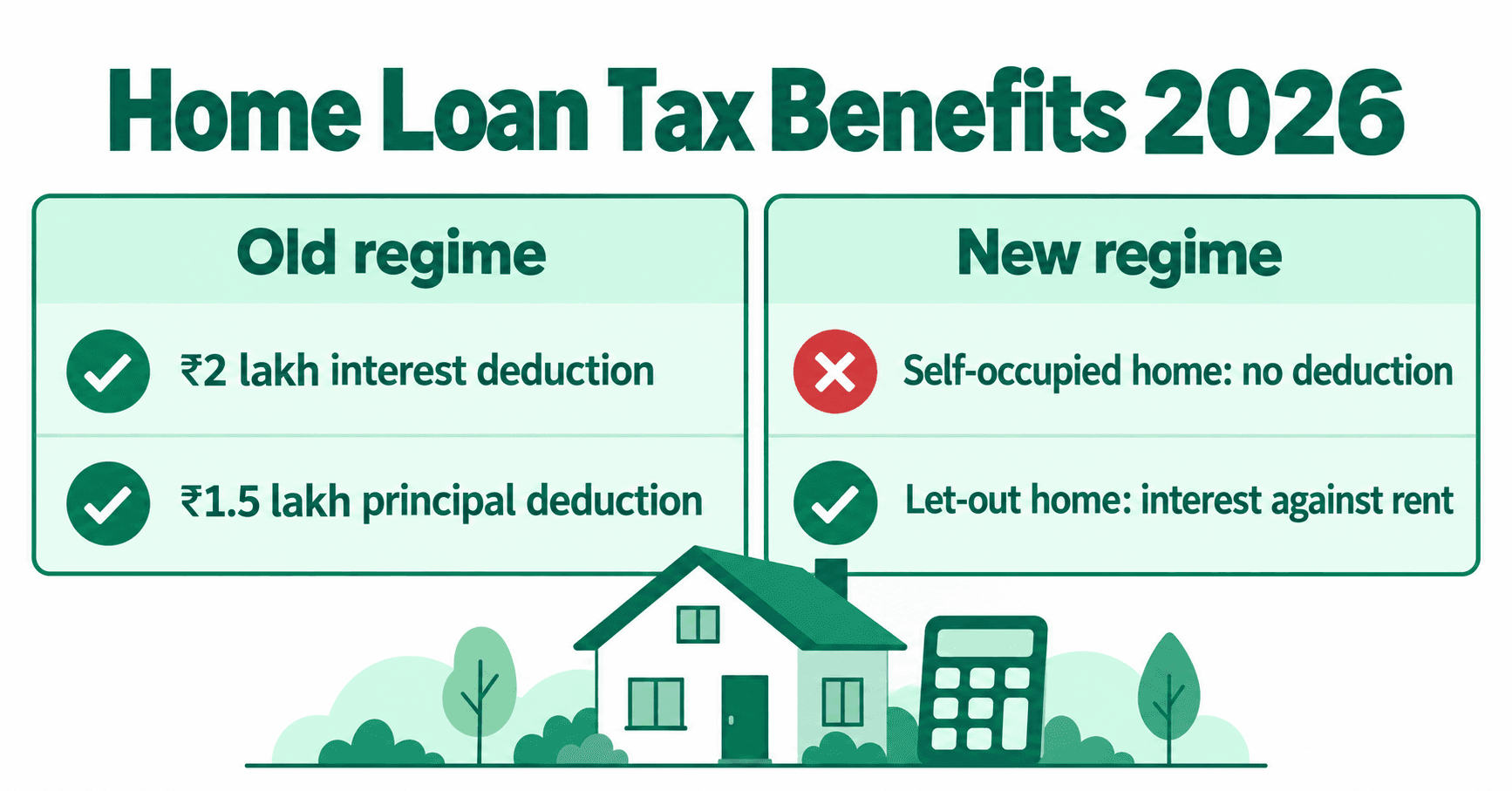
India's tax law changed on 1 April 2026. The Income-tax Act, 2025 replaced the 1961 Act, and almost every section got a new number. That's left a lot of home buyers asking whether the familiar home loan deductions still exist. The short answer is yes, mostly as before. The bigger question for most people is whether those deductions are still worth more than the lower tax rates of the new regime. For many salaried buyers, they aren't. This guide explains what you can claim and runs the numbers so you can see which regime suits you.
Quick summary
- The deductions are unchanged in substance. Only the section numbers changed when the new Act took effect on 1 April 2026.
- Old regime: up to ₹2 lakh a year for interest on a self-occupied home, plus up to ₹1.5 lakh for principal repayment (the old Section 80C limit, now Section 123).
- New regime (the default): no deduction for a self-occupied home. Interest on a rented-out home can still be set against the rent.
- Joint loans double up. Each co-owner who is also a co-borrower can claim their own limits under the old regime.
- For most salaried buyers, the new regime still works out cheaper, even after claiming every home loan deduction. Check your own numbers.
What changed on 1 April 2026
The Income-tax Act, 2025 is a rewrite of the old law in simpler language. It applies from tax year 2026-27, which started on 1 April 2026. It didn't change the tax slabs, and Budget 2026 left them as they were. The new regime is still the default, and you can still choose the old regime if it suits you. For home loans, the main differences are names and numbers. The old Section 80C deduction, which covers home loan principal along with PF, PPF and insurance, is now Section 123, with the same ₹1.5 lakh limit. The interest deduction that most people know as Section 24(b) is now Section 22, with the same ₹2 lakh limit for a self-occupied home.
Home loan tax benefits at a glance
| Benefit | Section (old → new) | Limit (old regime) | New regime |
|---|---|---|---|
| Interest on a self-occupied home | Section 24(b) (now Section 22) | Up to ₹2 lakh a year | Not available |
| Interest on a rented-out home | Section 24(b) (now Section 22) | No cap against rent; loss set-off limited to ₹2 lakh | Allowed against rent only; loss can't be set off or carried forward |
| Principal repayment | Section 80C (now Section 123) | Up to ₹1.5 lakh, shared with PF, PPF, insurance etc. | Not available |
| Stamp duty and registration | Section 80C (now Section 123) | Within the ₹1.5 lakh limit, in the year paid | Not available |
| Pre-construction interest | Section 24(b) (now Section 22) | Claimed in 5 equal parts from the year of possession, within the ₹2 lakh limit | Not available for a self-occupied home |
Based on the provisions as they stood under the 1961 Act, which secondary sources say carry over unchanged. Confirm with your CA before filing.
Old vs new regime: which saves more with a home loan?
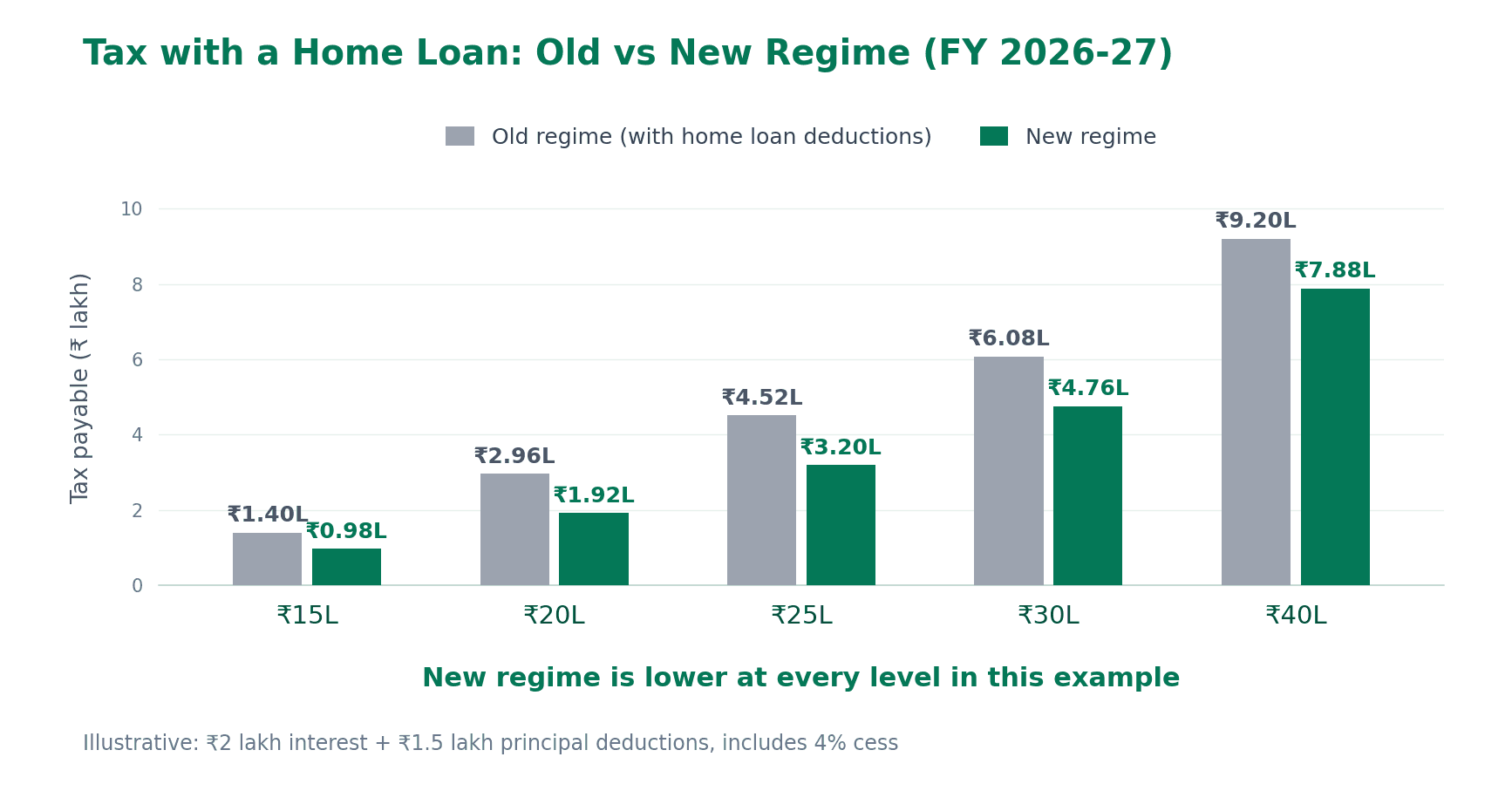
Here's a typical salaried buyer with an ₹80 lakh home loan at 7.5%. In the first year, they'll pay about ₹5.9 lakh in interest and ₹1.8 lakh in principal. Under the old regime, we've assumed they claim the full ₹2 lakh interest deduction, the full ₹1.5 lakh under Section 123 (old 80C), ₹25,000 for health insurance and the ₹50,000 standard deduction. Under the new regime, they just get the ₹75,000 standard deduction.
| Annual salary | Old regime, with all home loan deductions | New regime | Better choice |
|---|---|---|---|
| ₹15 lakh | ₹1,40,400 | ₹97,500 | New, by ₹42,900 |
| ₹20 lakh | ₹2,96,400 | ₹1,92,400 | New, by ₹1,04,000 |
| ₹25 lakh | ₹4,52,400 | ₹3,19,800 | New, by ₹1,32,600 |
| ₹30 lakh | ₹6,08,400 | ₹4,75,800 | New, by ₹1,32,600 |
| ₹40 lakh | ₹9,20,400 | ₹7,87,800 | New, by ₹1,32,600 |
Our calculation for FY 2026-27, including 4% cess, excluding surcharge. Old regime: ₹50,000 standard deduction, ₹1.5 lakh Section 123, ₹2 lakh home loan interest, ₹25,000 health insurance. New regime: ₹75,000 standard deduction. Illustrative only, not tax advice.
In this example, the new regime wins at every salary level, even with a large home loan. The new regime's lower rates are simply worth more than the old regime's deductions for most people. The old regime can still come out ahead if your total deductions are much larger, for example if you also claim HRA for part of the year, NPS contributions, education loan interest, or a joint loan where your spouse's tax situation matters too. Run both calculations every year. You can switch regimes each year if you're salaried.
What the main banks charge now, and how to get a lower rate.
Home Loan Interest Rates 2026Worked example: ₹15 lakh salary with a home loan
Say you earn ₹15 lakh a year and live in a flat you bought with a home loan. This year you pay ₹2 lakh or more in interest and ₹1.5 lakh or more towards the principal. You also pay ₹25,000 a year for health insurance.
Old tax regime: about ₹1.4 lakh
| Old regime | Amount |
|---|---|
| Salary | ₹15,00,000 |
| Less standard deduction | − ₹50,000 |
| Less home loan interest (Section 24(b), up to ₹2 lakh) | − ₹2,00,000 |
| Less principal repayment (Section 80C, up to ₹1.5 lakh) | − ₹1,50,000 |
| Less health insurance (Section 80D) | − ₹25,000 |
| Taxable income | ₹10,75,000 |
| Tax on the first ₹2.5 lakh | ₹0 |
| 5% on ₹2.5–5 lakh | ₹12,500 |
| 20% on ₹5–10 lakh | ₹1,00,000 |
| 30% on the remaining ₹75,000 | ₹22,500 |
| Tax before cess | ₹1,35,000 |
| Plus 4% health and education cess | ₹5,400 |
| Total tax | ₹1,40,400 |
New tax regime: ₹97,500
For a home you live in, the new regime gives you no deduction for home loan interest or principal, and no 80C or 80D. You get only the higher ₹75,000 standard deduction.
| New regime | Amount |
|---|---|
| Salary | ₹15,00,000 |
| Less standard deduction | − ₹75,000 |
| Taxable income | ₹14,25,000 |
| Tax on the first ₹4 lakh | ₹0 |
| 5% on ₹4–8 lakh | ₹20,000 |
| 10% on ₹8–12 lakh | ₹40,000 |
| 15% on the remaining ₹2.25 lakh | ₹33,750 |
| Tax before cess | ₹93,750 |
| Plus 4% cess | ₹3,750 |
| Total tax | ₹97,500 |
The ₹60,000 rebate under Section 87A doesn't apply, because taxable income is above ₹12 lakh.
What this means: even with the full home loan deductions, the new regime saves this buyer ₹42,900 a year. For the old regime to win at a ₹15 lakh salary, you'd need more than about ₹5.44 lakh of deductions on top of the ₹50,000 standard deduction. This example has ₹3.75 lakh. HRA can't help here either, since you live in your own flat. So compare both regimes with your own figures every year before you choose.
Joint home loans: twice the benefit
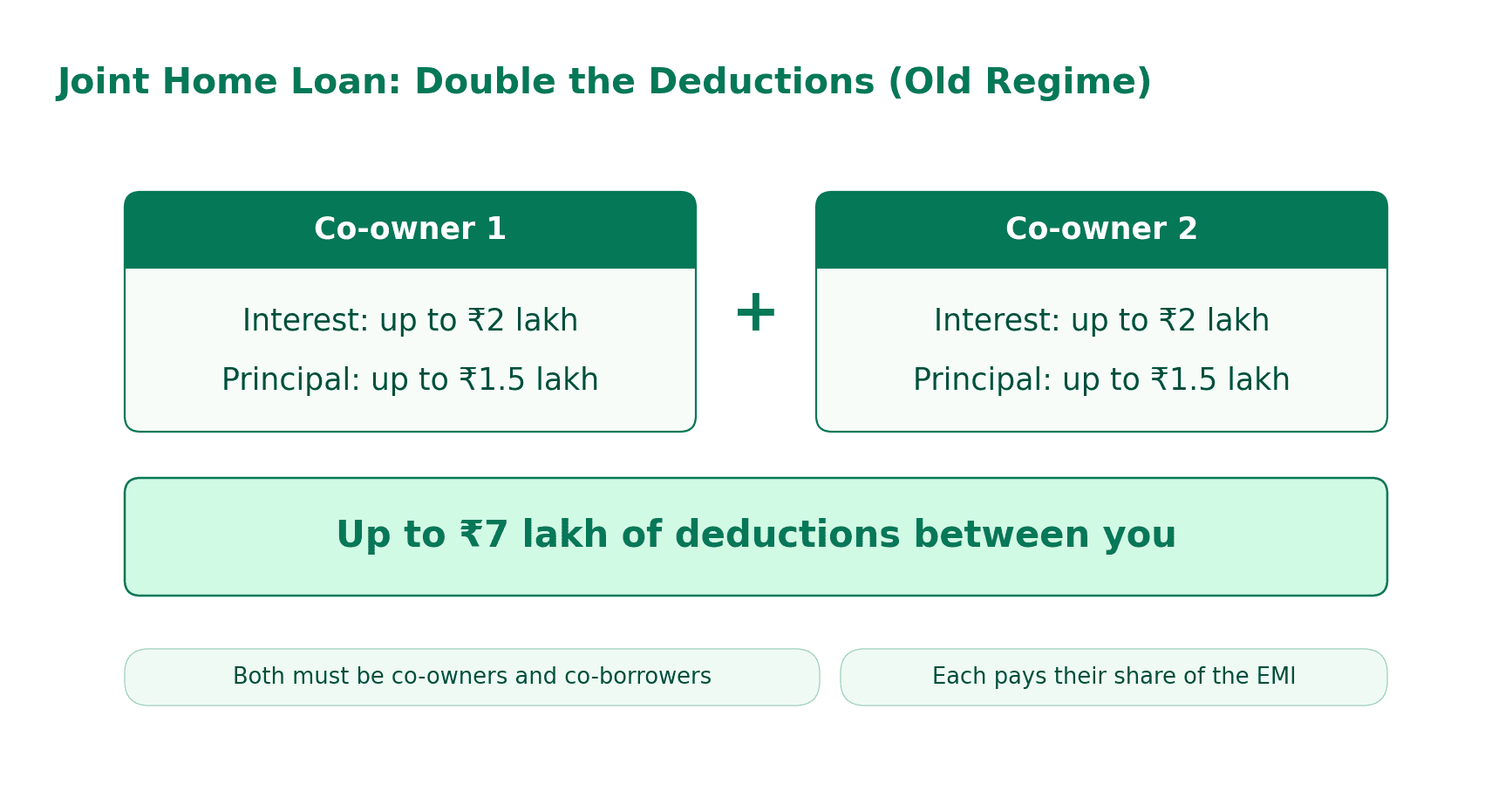
If you buy jointly with your spouse and you're both co-owners and co-borrowers, each of you can claim the old regime limits separately: up to ₹2 lakh for interest and ₹1.5 lakh for principal each. That's up to ₹7 lakh of deductions between you, which can tip the balance towards the old regime for one or both of you. Two conditions matter. Each person must be a co-owner of the property, not just a co-borrower, and each must actually pay their share of the EMI from their own income. Each of you can choose your own tax regime.
Rented-out and second homes
If you rent out your flat, the rules are more generous. Under both regimes, you can deduct all the home loan interest from the rent you receive, along with a 30% standard deduction for repairs. The new regime doesn't let you set a resulting loss against your salary, though. The old regime lets you set off up to ₹2 lakh of loss against other income and carry the rest forward for eight years. Under the old regime, you can treat up to two homes as self-occupied, but the ₹2 lakh interest limit is shared between them.
How to claim home loan tax benefits
- Get the interest certificate from your bank each year. It shows interest and principal paid during the financial year.
- Give it to your employer with your investment declaration so they deduct less TDS, if you've chosen the old regime.
- Claim it in your ITR if you didn't declare it to your employer. Keep the certificate, sale deed and possession letter safe.
- Claim stamp duty in the year you paid it, within the ₹1.5 lakh Section 123 limit.
- Don't sell within five years of the end of the year you got possession, or the principal deductions you've claimed are added back to your income.
Plan your home loan with the numbers
Tax benefits are a bonus, not a reason to buy. Start with an EMI you can afford, then see what the tax saving adds. Use our home loan calculator to work out your EMI, and our home loan eligibility guide to see how much you can borrow on your salary.
Work out your EMI, then see how much you can borrow on your salary.
Home Loan CalculatorNot sure which regime saves you more?
If you have any questions about how to reduce your tax on a home loan, book an appointment with one of our experts and we'll guide you. Just fill in your details on our Talk to an Expert page.
This article is for general information and isn't tax advice. Tax rules can change, and your own situation may differ. Please speak to a chartered accountant before you choose a regime or file your return.
Book a call and we'll help you plan your home loan.
Talk to an ExpertSources: Income-tax Act, 2025 (Wikipedia); ClearTax (Section 123 of the Income-tax Act, 2025); Bajaj Finserv (home loan exemption under the new regime); Motilal Oswal (new vs old tax regime after Budget 2026); BankBazaar (income tax slabs for FY 2026-27).
Frequently asked questions
Can I claim home loan interest under the new tax regime in 2026?
Not for a home you live in. The new regime doesn't allow a deduction for interest on a self-occupied home. If you rent the home out, you can deduct the interest from the rental income, but you can't set any loss against your salary.
What is the maximum tax benefit on a home loan?
Under the old regime, up to ₹2 lakh a year for interest on a self-occupied home and up to ₹1.5 lakh for principal repayment under Section 123 (the old Section 80C), which is shared with other investments like PF and PPF.
What replaced Section 80C under the Income-tax Act, 2025?
Section 123. It keeps the same ₹1.5 lakh limit and covers the same kinds of payments, including home loan principal, stamp duty and registration. It's only available under the old tax regime.
Is the old or new tax regime better if I have a home loan?
For many salaried buyers, the new regime still works out cheaper even after claiming the full home loan deductions. The old regime can win if you have large deductions such as a joint loan, HRA for part of the year, NPS and insurance. Calculate both every year.
Can both husband and wife claim tax benefits on a joint home loan?
Yes, under the old regime, if both are co-owners and co-borrowers and both pay towards the EMI. Each can claim up to ₹2 lakh for interest and ₹1.5 lakh for principal.
Can I claim tax benefits on an under-construction flat?
Not until construction is complete. Interest paid before possession can be claimed in five equal instalments starting from the year you get possession, within the ₹2 lakh limit. Principal repayments before possession can't be claimed.
Can I claim stamp duty under the tax deductions?
Yes, under the old regime. Stamp duty and registration can be claimed under Section 123 (old 80C) in the year you pay them, within the overall ₹1.5 lakh limit.
Do home loan tax benefits apply to a second home?
Under the old regime, you can treat two homes as self-occupied, but the ₹2 lakh interest limit is shared. If the second home is rented out, the interest can be deducted from the rent.
What happens if I sell my house within five years?
Under the old regime, the principal deductions you claimed under Section 123 (old 80C) are reversed and added to your income in the year you sell. The interest deductions aren't reversed.
Ready to find your next home?
Browse verified ready-to-move flats across Pune.