
Home Loan Interest Rates 2026: What the RBI Repo Rate Hike Means for Your EMI
12 October 2026 · 8 min read · Updated 24 October 2026
If you've been tracking home loan interest rates this year, 7 October changed the story. The Reserve Bank of India raised the repo rate by 0.25%, from 5.25% to 5.50%. It's the first hike since February 2023, and banks didn't wait long. By the next morning, Bank of Baroda, PNB, Bank of India and a few others had already raised their lending rates. We get the same three questions from buyers every time this happens. How much will my EMI go up? Which bank is still the cheapest? Should I buy now or wait? This post answers all three, with real numbers and nothing you need a finance degree to follow.
Quick summary
- Current repo rate: 5.50%, effective 7 October 2026. The RBI has shifted its stance to "calibrated tightening", which means more hikes are possible.
- Lowest home loan interest rates now: about 7.25% at Bank of Maharashtra and 7.50% at SBI, after banks passed on the hike. HDFC Bank starts at 8.00% and ICICI Bank at 8.75%.
- EMI increase: about ₹1,217 a month on an ₹80 lakh loan over 20 years, or ₹761 a month on ₹50 lakh.
- When it hits you: floating-rate loans linked to the repo rate usually reset within one to three months.
- Next RBI meeting: 2 to 4 December 2026.
Why did the RBI raise the repo rate in October 2026?
In one word: inflation. Retail inflation rose to 4.8% in August, up from 4.5% in July, and the RBI now expects it to average 5.2% for 2026-27. It warned that inflation could touch nearly 5.8% over the next three quarters. Crude oil prices, a weak monsoon and El Niño are the big worries. At the same time, the economy is doing well, with growth projected at 7.1% this year. That gave the RBI room to tighten without much fear of slowing things down. All six members of the Monetary Policy Committee voted for the hike. The RBI also said plainly that rate cuts are off the table for now, so anyone waiting for home loan rates to drop again may be waiting a while.
How does a repo rate hike increase your home loan EMI?
Since 2019, almost every new floating-rate home loan in India has been linked to an external benchmark, which is usually the RBI repo rate. The chain works like this:
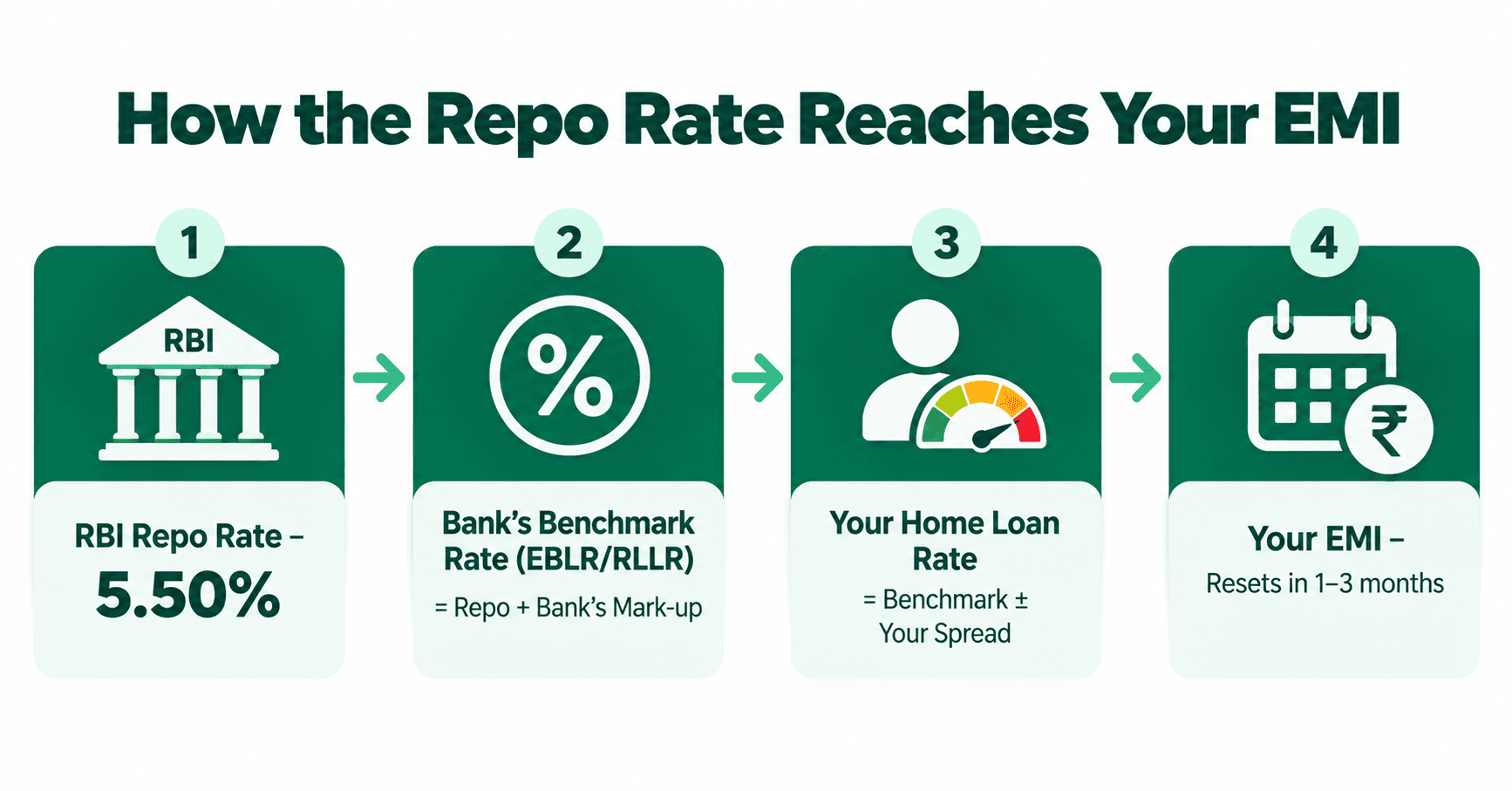
Your bank adds its own mark-up to the repo rate to get its benchmark lending rate. Banks call it EBLR, RLLR or RBLR, but it's the same idea. Bank of Baroda's mark-up, for example, is 2.65%. Your own rate is that benchmark plus or minus a spread, which depends mostly on your credit score, whether you're salaried or self-employed, and your loan amount. The important part is that your spread stays fixed for the life of the loan. So when the repo rate goes up by 0.25%, your rate goes up by exactly 0.25%. Older loans linked to MCLR move more slowly, at their annual or half-yearly reset. Fixed-rate loans don't change at all during the fixed period.
Which banks have raised home loan rates after the repo hike?
By 8 October, the day after the RBI announcement, at least seven banks had raised their repo-linked lending rates by the full 0.25%. Bank of Baroda went to 8.15%, Indian Bank to 8.20%, Bank of Maharashtra to 8.30%, PNB, Bank of India and Indian Overseas Bank to 8.35%, and Tamilnad Mercantile Bank to 8.50%.
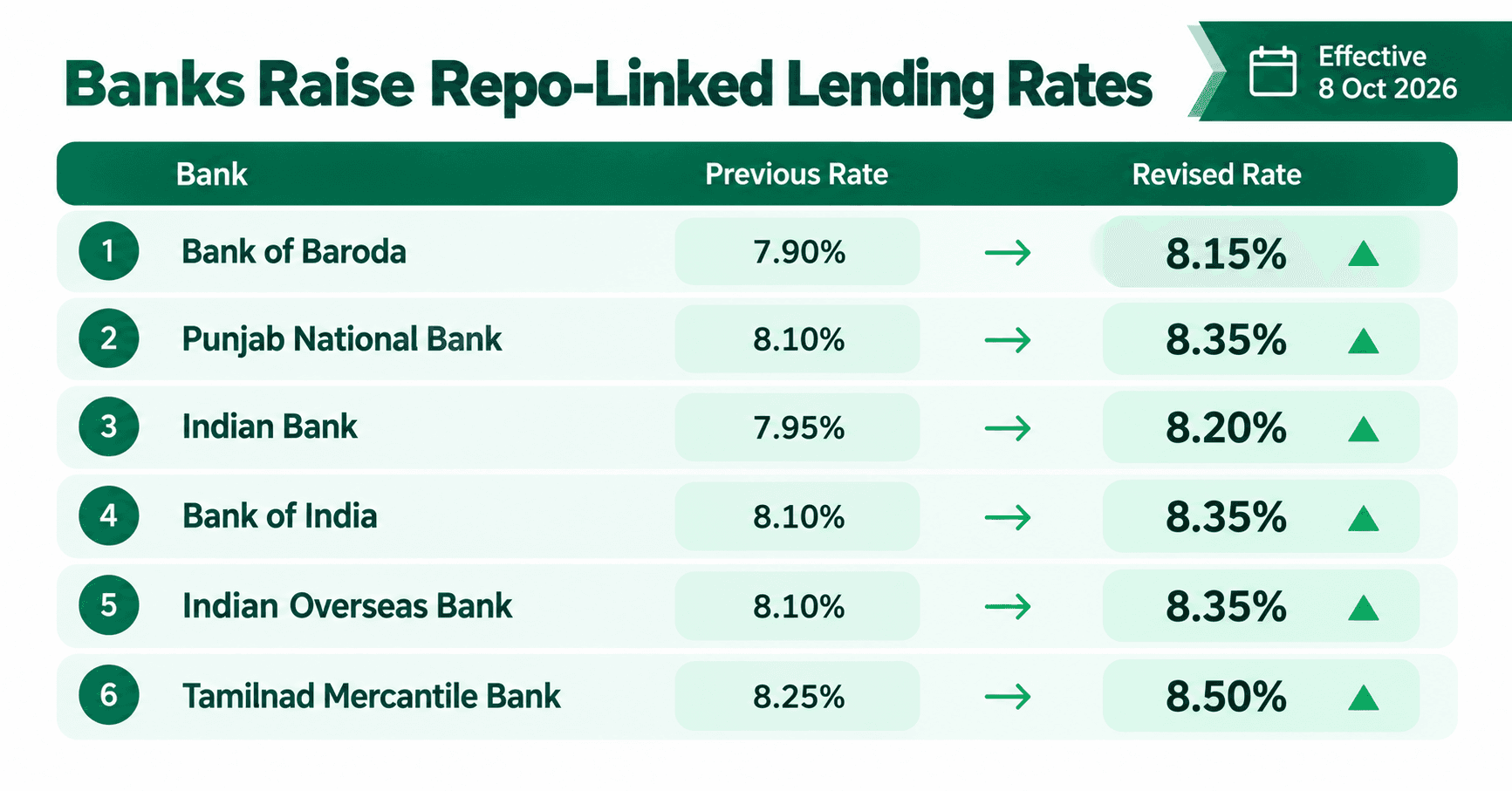
These are the banks' benchmark rates, not the rate you'll be quoted. Sources: Outlook Money and Business Standard, 8 and 9 October 2026.
SBI followed on 15 October, raising its external benchmark rate (EBLR) from 7.90% to 8.15%, which moved its home loan rates to 7.50%–8.80%. HDFC Bank's home loans are now priced at the repo rate plus 2.50% upwards, so they start at 8.00%. ICICI Bank's standard rate for salaried borrowers starts at 8.75%, with 7.80% offered only on pre-approved online sanctions until 31 October. We couldn't confirm a revision from Axis Bank or Kotak by 24 October. If your loan is repo-linked, assume the 0.25% increase reaches you at your next reset.
Lowest home loan interest rates in India right now
Here's how the lowest starting rates have moved since the hike, as of 24 October 2026. These are the rates offered to the strongest applicants, usually salaried borrowers with a credit score above 750 to 800.
| Lender | Before the hike | Now (24 Oct) | What changed |
|---|---|---|---|
| Bank of Maharashtra | 7.00% | 7.25%* | Benchmark raised 0.25% from 7 Oct |
| Central Bank of India | 7.10% | 7.10% | No change announced yet |
| Bank of India | 7.10% | 7.35%* | Benchmark raised 0.25% from 7 Oct |
| Union Bank of India | 7.15% | 7.15% | No change announced yet |
| LIC Housing Finance | 7.15% | 7.15% | No change announced yet |
| Bank of Baroda | 7.20% | 7.45%* | Benchmark raised 0.25% from 8 Oct |
| State Bank of India (SBI) | 7.25% | 7.50% | Rates raised from 15 Oct |
| Punjab National Bank | 7.25% | 7.50%* | Benchmark raised 0.25% from 8 Oct |
| South Indian Bank | 7.25% | 7.25% | No change announced yet |
| Punjab & Sind Bank | 7.35% | 7.35% | No change announced yet |
| Saraswat Bank | 7.35% | 7.35% | No change announced yet |
| Federal Bank | 7.35% | 7.35% | No change announced yet |
| HDFC Bank | — | 8.00% | Repo rate + 2.50% upwards |
| ICICI Bank | — | 8.75% | 7.80% for pre-approved online loans until 31 Oct |
* Starting rate before the hike plus the bank's 0.25% benchmark increase; banks keep each borrower's spread unchanged. Lenders marked "no change announced yet" are likely to follow. Sources: Upstox (7 Oct, pre-hike rates), bank rate notices and rate pages (Bank of Maharashtra, SBI, HDFC Bank, ICICI Bank), Outlook Money (8 Oct) and Business Today (18 Oct).
Bank of Maharashtra, which is headquartered right here in Pune, still has the lowest starting rate after the hike. The gap between public sector and private banks has widened: SBI starts at 7.50%, while HDFC Bank starts at 8.00% and ICICI Bank at 8.75% for most borrowers. Private banks can still sharpen their offer for salaried buyers with strong credit and a good relationship with the bank, so it's worth asking.
How much will your EMI go up?
Say you're buying a 3BHK in Baner or Kharadi for around ₹1.1 crore, with a home loan of ₹80 lakh over 20 years. Here's what the hike does to your EMI, and what happens if the RBI raises rates once more in December, which several economists expect.
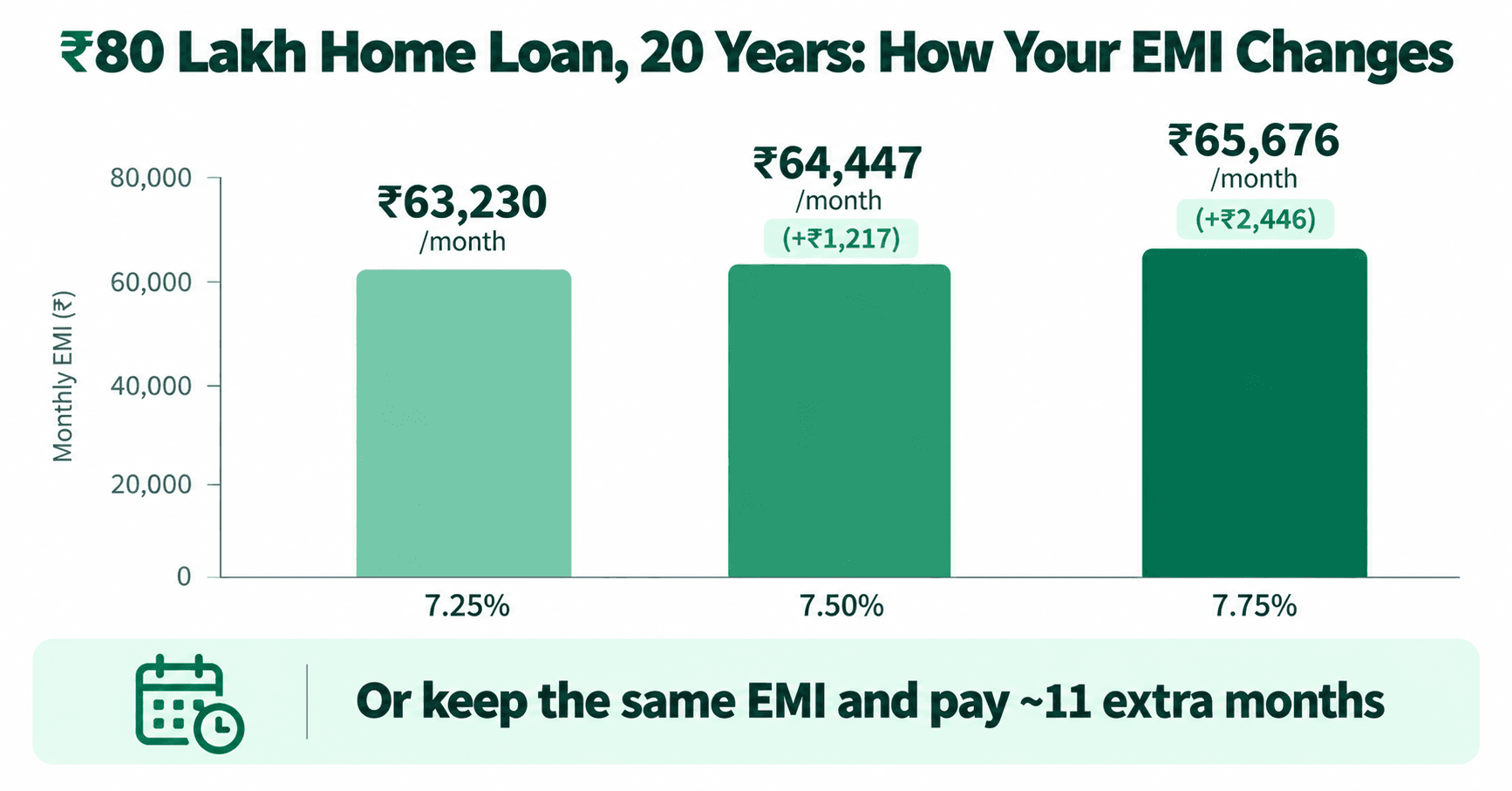
20-year loan, monthly reducing balance. On ₹50 lakh, the EMI goes from ₹39,519 to ₹40,280.
On the ₹80 lakh loan, 0.25% works out to ₹1,217 more every month and roughly ₹2.9 lakh more in interest over 20 years. There's a catch many borrowers miss. A lot of banks don't raise your EMI at all. They quietly extend your loan tenure instead. On the same ₹80 lakh loan, keeping the EMI at ₹63,230 stretches the loan by about 11 months. You won't feel it now, but you'll pay for it at the end, because you pay interest for longer.
What the rate hike means if you're buying a ready-to-move flat in Pune
With a ready-to-move flat, the bank usually releases the full loan amount at registration. Your full EMI starts from the first month, so the rate you get on day one matters more than it does for an under-construction purchase. But there's a real advantage too. You aren't paying pre-EMI interest on a flat you can't move into while also paying rent somewhere else. Every EMI you pay reduces your principal from the very first month, and you can see exactly what you're buying before you sign. If rents in your area are close to the EMI, moving in sooner often matters more than a 0.25% difference in the interest rate.
Rates are rising: what to do now
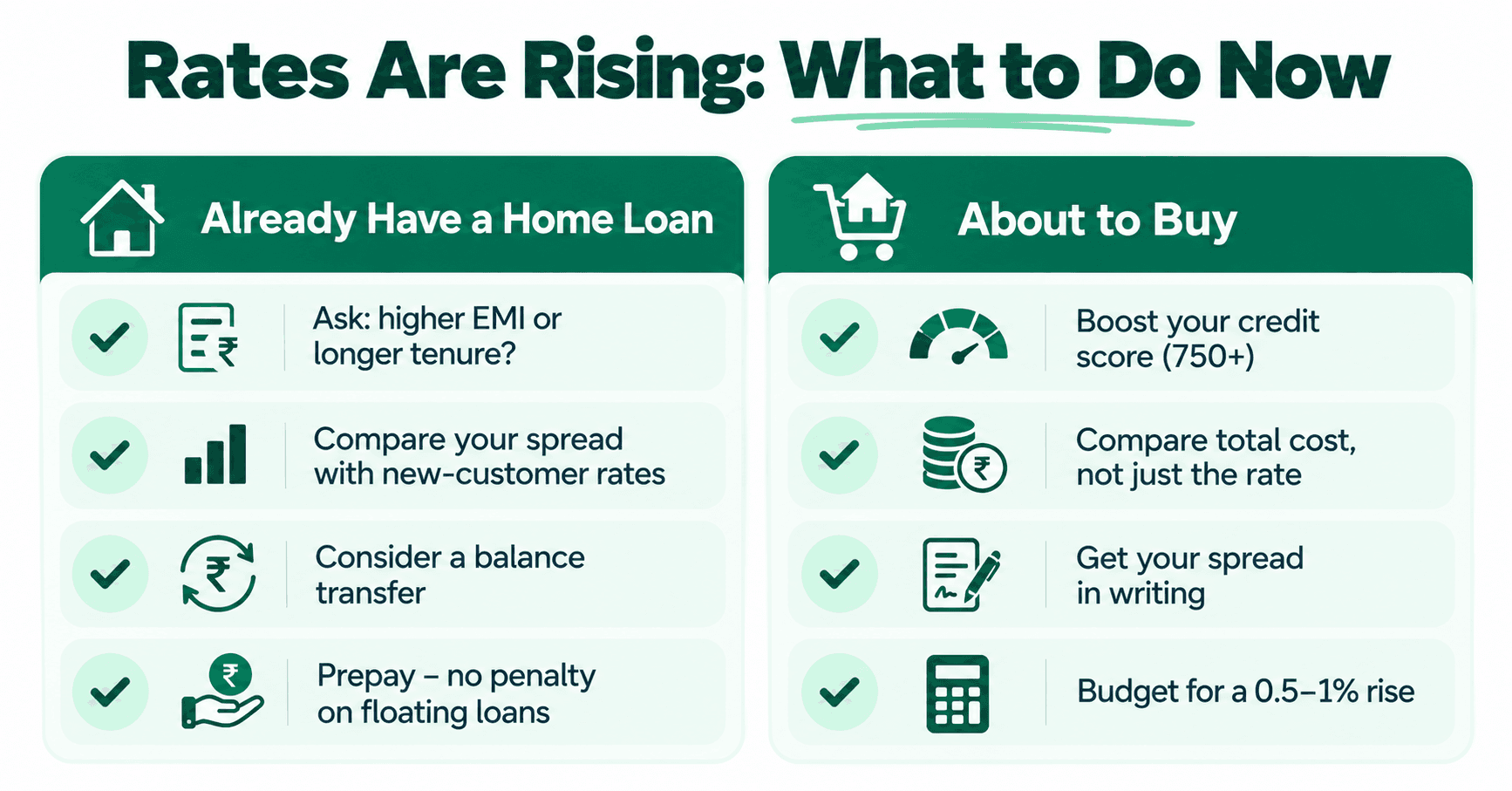
If you already have a home loan:
- Ask your bank: higher EMI or longer tenure? If you can afford it, choose the higher EMI. It keeps your loan on schedule and saves you interest.
- Compare your rate with what new customers get. Existing borrowers often pay more than new ones. If your rate is 0.5% or more above the bank's current offer, ask to switch to the new rate. There's usually a small one-time fee.
- Think about a home loan balance transfer. If your bank won't budge, another lender might. A 1% lower rate on an ₹80 lakh, 20-year loan saves about ₹11.8 lakh in interest. Just check the new lender's processing fee first.
- Prepay whenever you can. Under RBI rules, banks can't charge individuals a penalty for prepaying a floating-rate home loan. Even one extra EMI a year makes a noticeable dent in your total interest.
If you're about to buy:
- Get your credit score above 750. The best home loan interest rates go to scores of 750 to 800 and above. Pay off card dues and avoid applying for new loans or cards for a few months before you apply.
- Compare the total cost, not just the rate. Processing fees range from zero to 1% or 2% of the loan. Legal, valuation and MODT charges add up too. Ask every lender for a written breakdown. Our Home Loan Checklist guide covers these charges in detail.
- Get your spread in writing. You can't control the repo rate, but you can negotiate your spread. Make sure the sanction letter states it clearly.
- Weigh fixed against floating. Fixed-rate home loans usually start higher and often switch to floating after a few years. With more hikes possible, some buyers prefer the certainty. Compare the actual numbers before deciding.
- Leave yourself a buffer. Make sure you could still pay comfortably if rates rose by another 0.5% to 1%.
Rates and policies change often. This article is for general information and isn't financial advice. Please confirm current rates and terms with your lender before you decide.
Already paying off a home loan? See how much you could save by moving to a lower rate.
Check My Home Loan SavingsFrequently asked questions
What is the current RBI repo rate?
The repo rate is 5.50%. The RBI raised it from 5.25% on 7 October 2026, its first increase since February 2023. The next policy meeting is from 2 to 4 December 2026.
Which bank has the lowest home loan interest rate in 2026?
As of 24 October 2026, the lowest advertised starting rates are around 7.10% to 7.15% at lenders that haven't yet passed on the October hike (Central Bank of India, Union Bank of India and LIC Housing Finance), and about 7.25% at Bank of Maharashtra after its increase. SBI starts at 7.50%. These rates are for borrowers with excellent credit, and the lenders that haven't revised yet are likely to add about 0.25%.
What is the SBI home loan interest rate now?
SBI raised its home loan rates by 0.25% from 15 October 2026, after the RBI's repo rate hike. Regular home loans now range from 7.50% to 8.80% p.a., depending mainly on your credit score, and its external benchmark rate (EBLR) is 8.15%.
Will my home loan EMI increase after the repo rate hike?
If you have a floating-rate loan linked to the repo rate, yes, usually within one to three months at your next reset date. Your bank may increase the EMI or extend your tenure instead. Fixed-rate loans aren't affected during the fixed period, and MCLR-linked loans change only at their annual or half-yearly reset.
How much is the EMI on a ₹50 lakh home loan?
At 7.50% interest, the EMI on a ₹50 lakh home loan is ₹40,280 a month over 20 years, or ₹34,961 a month over 30 years. At 7.25%, the 20-year EMI is ₹39,519, so the October hike adds about ₹761 a month.
Does the repo rate hike affect existing home loans?
Yes, if your existing loan is on a floating rate linked to the repo rate. Your spread stays the same, but the benchmark rises by 0.25%, so your interest rate rises by the same amount. Ask your bank whether it will raise your EMI or extend your tenure.
Should I choose a fixed or floating home loan in 2026?
Floating rates are usually lower to begin with and go down when the RBI cuts rates. Fixed rates cost more upfront but protect you if rates keep rising, and many are fixed only for the first few years. If a predictable EMI matters more to you than the lowest possible rate, compare both offers from the same bank.
How can I reduce my home loan interest rate?
Ask your current bank to move you to its latest rate for new customers, which usually costs a small conversion fee. If it refuses, consider a balance transfer to a cheaper lender. Improving your credit score, adding a co-applicant with good income, and prepaying part of the loan all help too.
What CIBIL score do I need for the lowest home loan rate?
Most banks reserve their best home loan interest rates for credit scores of 750 to 800 and above. Below 700, you'll usually pay a higher spread, and some lenders may ask for a larger down payment.
Is it a good time to buy a house in Pune in 2026?
Higher rates add a little to your EMI, about ₹1,200 a month on an ₹80 lakh loan, but that's small next to the price of the home itself. The RBI has signalled that rate cuts are unlikely soon, so waiting for cheaper loans is a gamble. If you've found the right ready-to-move flat at a fair price, the rate hike alone isn't a reason to hold back.
Do women get a lower home loan interest rate?
Many lenders offer women borrowers a small concession, often around 0.05%. In Maharashtra, registering the flat solely in a woman's name also reduces stamp duty by 1%, which saves ₹1 lakh on a ₹1 crore flat.
Ready to find your next home?
Browse verified ready-to-move flats across Pune.