
Carpet Area vs Built-Up Area vs Super Built-Up Area: What You're Really Paying For
5 November 2026 · 8 min read
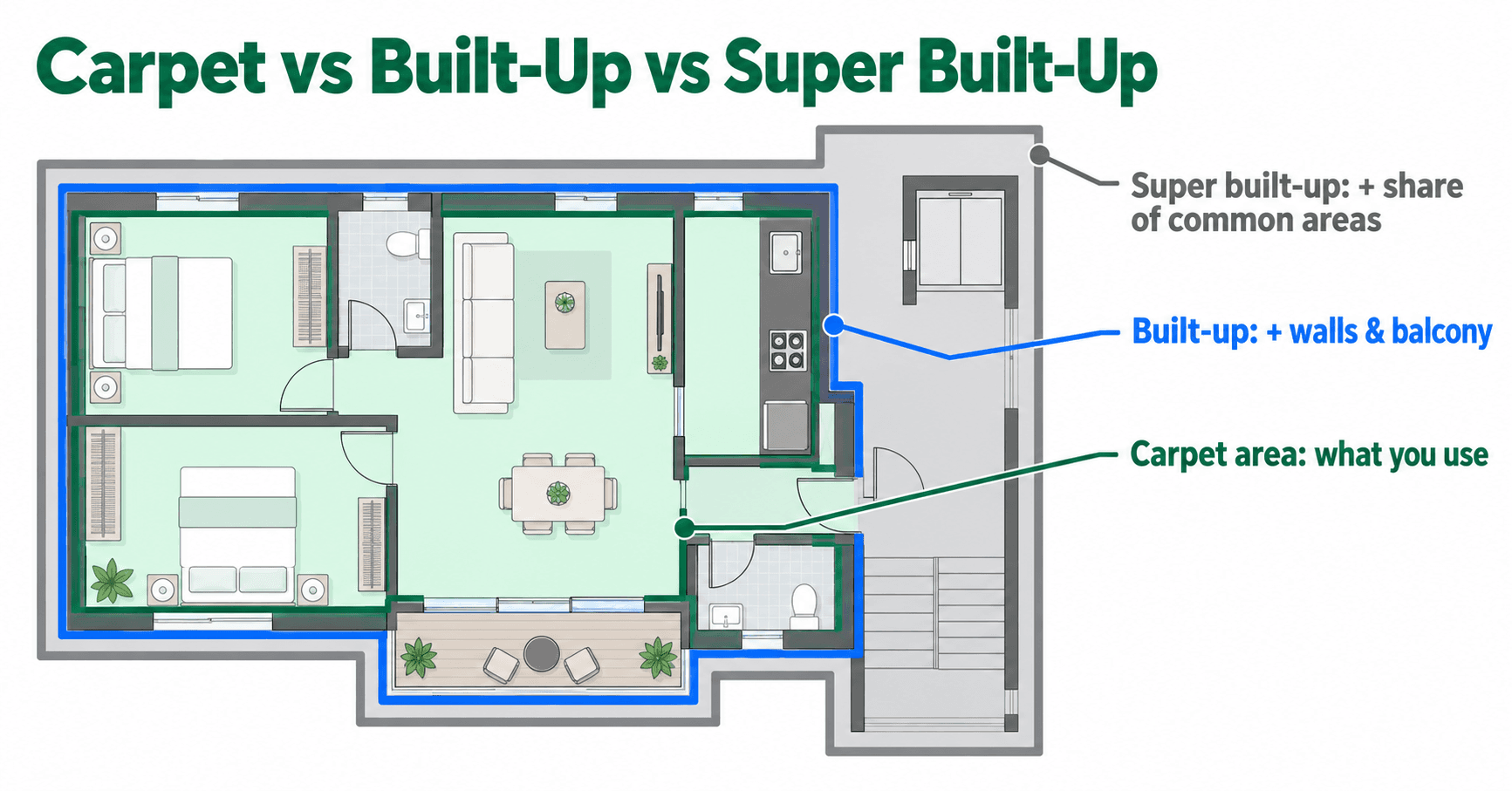
Two 2BHK flats in the same part of Pune are both advertised at "1,000 sq ft". One feels noticeably bigger when you walk in. That's not your imagination. One is probably quoting carpet area, and the other super built-up area, and the gap between them can be 30% or more. Since RERA came in, builders have to state the carpet area of every flat. But brochures, listings and conversations still mix all three measures, and it makes comparing prices very confusing. Here's what each one means and how to compare flats properly.
Quick summary
- Carpet area is the usable floor area inside your flat's walls. RERA requires it to be stated, and you can only be charged on it for new flats.
- Built-up area is carpet area plus the thickness of the walls and your balcony. It's usually 10% to 15% more than carpet.
- Super built-up area adds a share of common areas like the lobby, lifts and staircases. It's often 25% to 40% more than carpet.
- Loading is the gap between super built-up and carpet area. Higher loading means less usable space for your money.
- Always compare price per square foot of carpet area. It's the only fair comparison.
What is carpet area?
Carpet area is the space you actually live in: the floor area inside the walls of your flat. It's defined in Section 2(k) of the Real Estate (Regulation and Development) Act, 2016, the RERA Act. MahaRERA doesn't have a definition of its own; it applies this one to every project registered in Maharashtra. The Act says: “carpet area” means the net usable floor area of an apartment, excluding the area covered by the external walls, areas under services shafts, exclusive balcony or verandah area and exclusive open terrace area, but includes the area covered by the internal partition walls of the apartment. Explanation.— For the purpose of this clause, the expression “exclusive balcony or verandah area” means the area of the balcony or verandah, as the case may be, which is appurtenant to the net usable floor area of an apartment, meant for the exclusive use of the allottee; and “exclusive open terrace area” means the area of open terrace which is appurtenant to the net usable floor area of an apartment, meant for the exclusive use of the allottee.
Section 2(k), Real Estate (Regulation and Development) Act, 2016.
In simple terms, it's the area of your rooms, kitchen and bathrooms, plus the thin walls between them. It doesn't include the outer walls, your balcony or anything outside your front door. You'll often hear carpet area described as "the area where you can lay a carpet". That isn't how the law defines it, and it's misleading both ways: the internal walls between your rooms are counted, though you can't lay a carpet on them, while your balcony and terrace aren't, though you could. Under RERA, builders must sell new flats on carpet area, and the carpet area must be written in your agreement for sale and on the MahaRERA project page. If the carpet area you get is smaller than what's in the agreement, you can raise it with the builder and with MahaRERA.
What is built-up area?
Built-up area is carpet area plus the thickness of the external walls, plus your balcony or any other space that belongs only to your flat. It's what you'd measure from the outside of the flat's walls. Typically, it's 10% to 15% more than the carpet area.
What is super built-up area?
Super built-up area, also called saleable area, is the built-up area plus your share of the building's common areas: the entrance lobby, lifts, staircases, corridors, and sometimes the clubhouse, gym or other amenities. The share is usually worked out in proportion to the size of each flat. Before RERA, most flats in India were priced on super built-up area. Builders can no longer sell new flats that way, but many resale listings and older brochures still quote it, which is why it's important to know which figure you're looking at.
A Pune example
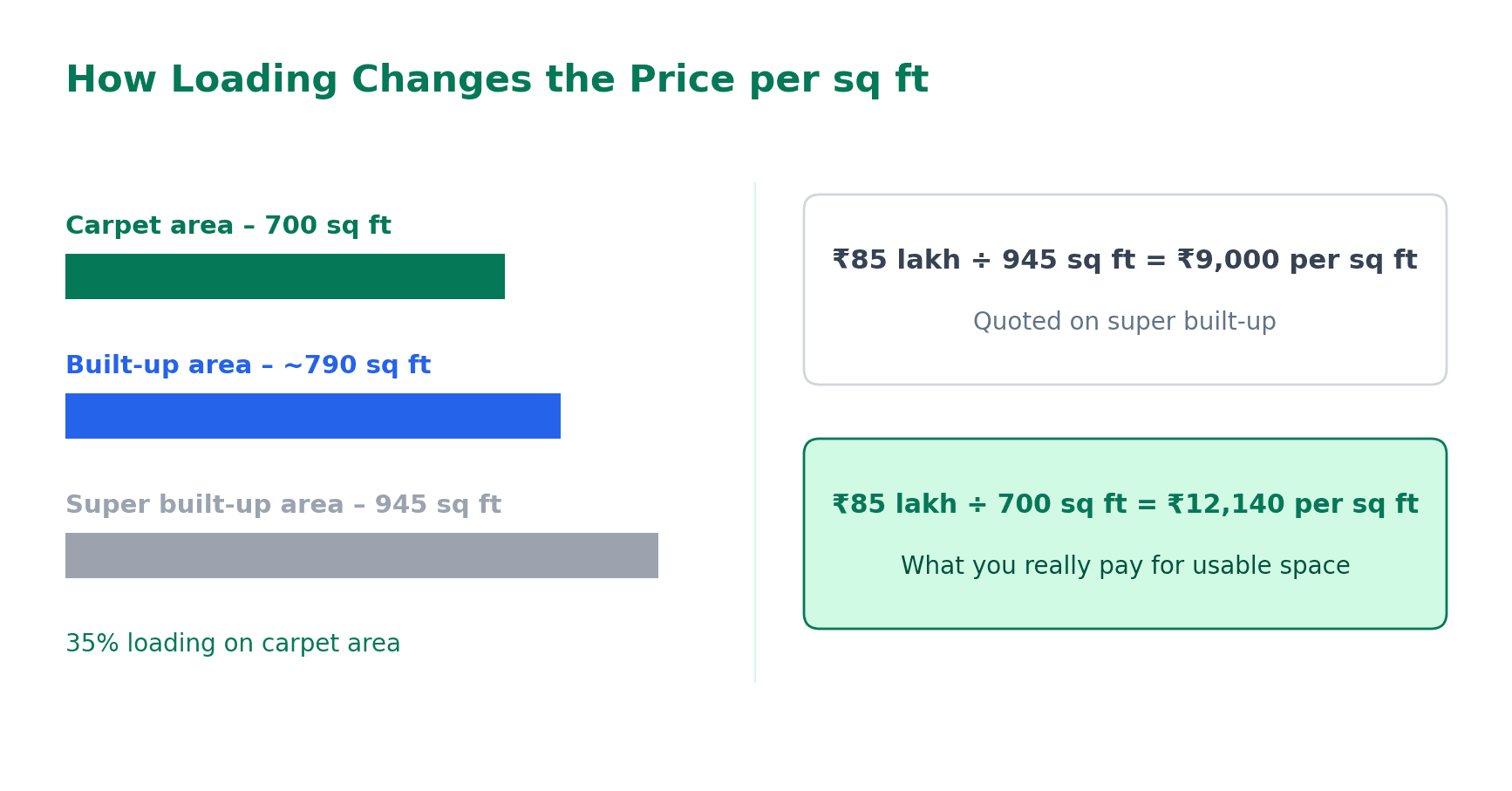
Say you're looking at a 2BHK priced at ₹85 lakh. The listing says "945 sq ft" and a rate of ₹9,000 per square foot. That sounds cheaper than the ₹12,000 per square foot you've seen quoted elsewhere in the same area.
| Measure | Area | Price per sq ft at ₹85 lakh |
|---|---|---|
| Carpet area (RERA) | 700 sq ft | ₹12,140 |
| Built-up area (about 13% more) | About 790 sq ft | ₹10,760 |
| Super built-up area (35% loading) | 945 sq ft | ₹9,000 |
Illustrative example. Loading differs from project to project.
It's the same flat at the same price. The only thing that changed is the area used to divide it. This is also why price-per-square-foot figures on property sites vary so much. Some use carpet area, some use super built-up, and many don't say which.
What is loading, and how much is normal?
Loading is how much bigger the super built-up area is than the carpet area, as a percentage. In the example above, 945 sq ft is 35% more than 700 sq ft, so the loading is 35%. Typical loading ranges from about 25% to 40%, and it can be higher in towers with large lobbies, many lifts or big amenity areas. More loading isn't always bad, because you're getting those amenities, but you should know what you're paying for.
| Type of project | Typical loading |
|---|---|
| Older low-rise buildings without lifts | 15% to 25% |
| Standard mid-rise with lifts | 25% to 35% |
| High-rise towers with large amenities | 35% to 45% or more |
Ranges commonly quoted by industry sources. Check the actual carpet area of the flat you're considering.
Does carpet area include the balcony?
No. Under RERA, exclusive balconies, verandas and open terraces aren't part of carpet area. The Act makes builders show them separately: when a project is registered, Section 4(2)(h) requires the builder to disclose "the number, type and the carpet area of apartments for sale in the project along with the area of the exclusive balcony or verandah areas and the exclusive open terrace areas…". Your agreement for sale shows them as separate figures too. So when you compare two flats, check the balcony areas separately as well, because a flat with a smaller carpet area but a large usable balcony may suit you better.
When does a terrace or balcony count in carpet area?
The Act doesn't mention covered or enclosed terraces directly. Applying its wording, what decides it is whether the space is enclosed and approved as part of the flat's rooms, not whether it has a roof:
- Open terrace attached to your flat, used only by you: not carpet area. It's an "exclusive open terrace area", which Section 2(k) excludes by name.
- Terrace with a roof but open on the sides: not carpet area. It works as a verandah or balcony, and those are excluded too.
- Balcony opening off a room, open or with a grille: not carpet area.
- Space fully enclosed with walls or windows and shown as part of the flat's rooms in the approved building plan: carpet area. It's part of the flat's net usable floor area.
- Terrace or balcony the owner encloses later without approval: not carpet area, and enclosing it may be an unauthorised change.
- Common terrace, such as the building's roof: never part of your carpet area. It's a common area, counted in super built-up area.
Builders often quote one combined figure, such as "carpet 750 + terrace 150 = 900 sq ft". They can charge for an exclusive terrace, but the RERA carpet area there is 750 sq ft. Work out the price per square foot on that figure, treat the terrace as an extra, and if a builder counts a covered terrace as carpet area, check how it's shown on the approved floor plan.
Older flats: carpet area under MOFA
Before RERA came into force in Maharashtra on 1 May 2017, flats were sold under the Maharashtra Ownership Flats Act, 1963 (MOFA). MOFA had no precise formula for carpet area, and it asked builders to disclose the carpet area of a flat including its balconies. So if you're buying a resale flat whose original agreement was signed before May 2017, the "carpet area" on paper may include the balcony, and it won't match the RERA figure for a similar new flat. Measure the flat, or work out its RERA carpet area, before you compare prices per square foot.
How to compare flats fairly
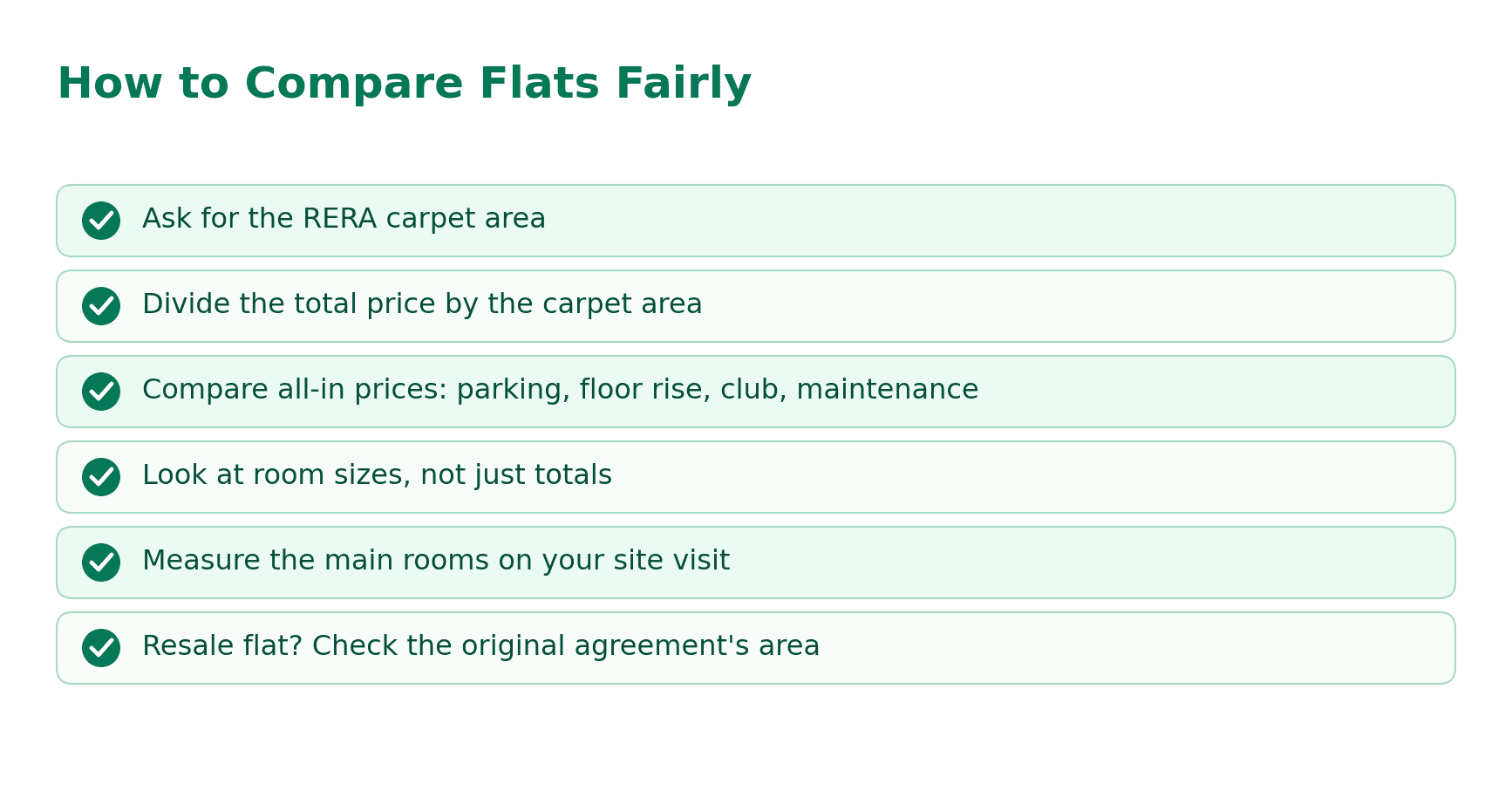
- Always ask for the RERA carpet area. It's in the agreement and on the MahaRERA project page.
- Divide the total price by the carpet area to get the real price per square foot.
- Compare all-in prices. Include parking, floor rise, club and maintenance charges in the total before you divide.
- Look at room sizes, not just totals. A flat with a slightly smaller carpet area but a better layout can feel more spacious.
- Measure on your site visit. For a ready-to-move flat, you can roughly measure the main rooms and compare with the plan.
- For resale flats, check the original agreement. Older agreements may show built-up or super built-up area. Ask for the carpet area too.
Check the OC online before you buy, along with the carpet area.
How to Check an Occupancy CertificateSee the carpet area before you visit
Our listing pages show the carpet area where it's been provided, so you can compare like with like. Browse current listings across Pune, or talk to our team if you'd like help comparing a few options.
Sources: Real Estate (Regulation and Development) Act, 2016, Sections 2(k) and 4(2)(h); Housing.com (RERA carpet area: how the definition changed); PropNewz (carpet area vs super built-up area); Chandak Group (carpet, built-up and super built-up area explained); MahaRERA project search.
Ready-to-move homes across Pune, each with its Occupancy Certificate.
Browse Ready-to-Move FlatsFrequently asked questions
What is carpet area according to RERA?
It's the net usable floor area of a flat, excluding the external walls, service shafts, exclusive balconies or verandas and exclusive open terraces, but including the internal partition walls.
What is the difference between carpet area and built-up area?
Built-up area is carpet area plus the thickness of the external walls and your exclusive balcony. It's usually 10% to 15% more than carpet area.
What is super built-up area?
It's the built-up area plus your share of common areas like the lobby, lifts, staircases and amenities. It's often 25% to 40% more than the carpet area.
How do I calculate carpet area from super built-up area?
Divide the super built-up area by 1 plus the loading. For example, with 35% loading, 945 sq ft super built-up ÷ 1.35 = 700 sq ft carpet area. The exact figure is in the agreement and on the MahaRERA project page.
What is a good loading percentage?
Around 25% to 35% is common for standard mid-rise and high-rise projects. Higher loading isn't necessarily bad if it pays for amenities you'll use, but it means less space inside your flat for the price.
Can a builder charge on super built-up area?
Not for new flats in RERA-registered projects. The price must be based on carpet area, and the carpet area must be stated in the agreement.
Does carpet area include balcony and terrace?
No. Under RERA, exclusive balconies, verandas and open terraces are stated separately, not included in carpet area.
Can a terrace be included in RERA carpet area?
Only if it's fully enclosed with walls or windows and shown as part of the flat's rooms in the approved building plan. An open terrace attached to your flat, a covered terrace that's open on the sides and a balcony aren't part of RERA carpet area. The builder must state their areas separately, and can charge for them.
Where can I check the carpet area of a flat?
In your agreement for sale and on the project's MahaRERA page, which lists the carpet area for each type of flat in the project.
Why do price per sq ft figures vary so much between websites?
Because some use carpet area and others use super built-up area. The same flat can be ₹9,000 per sq ft on super built-up and over ₹12,000 per sq ft on carpet area.
Ready to find your next home?
Browse verified ready-to-move flats across Pune.