
How Much Home Loan Can I Get on My Salary? (2026 Eligibility Guide)
12 October 2026 · 8 min read · Updated 24 October 2026
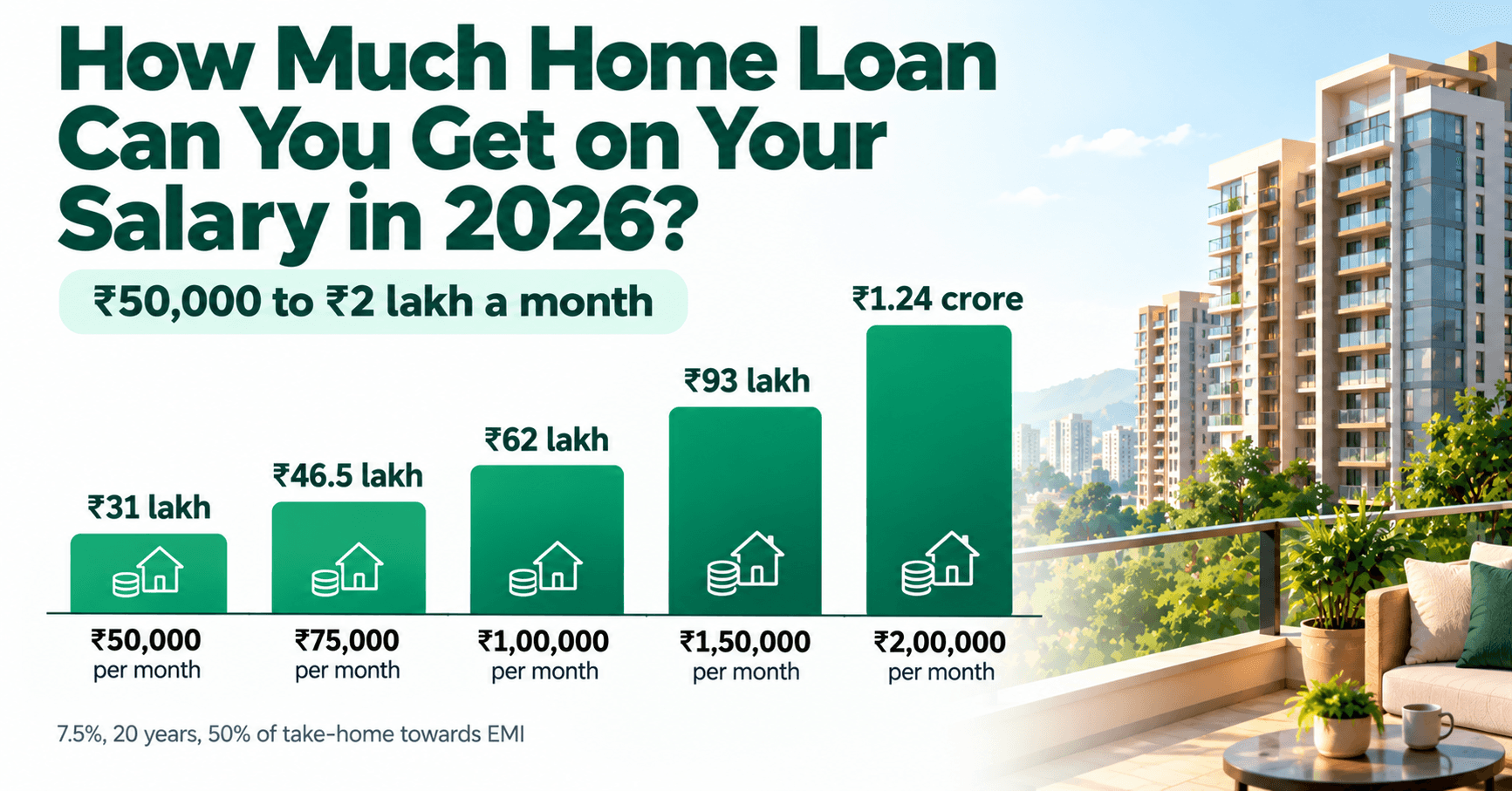
It's the first question almost every buyer asks, usually before they've even looked at a flat. And the answer most people get, "about 60 times your salary", is close enough to start with but not much more than that. Your home loan eligibility depends on four things: what you take home each month, what EMIs you already pay, the interest rate, and how long you borrow for. The RBI's repo rate hike on 7 October has nudged rates up, which means the same salary now gets you a slightly smaller loan than it did in September. This guide shows you the real numbers, how banks work them out, and how to legitimately borrow more if you need to.
Quick summary
- Rule of thumb: most banks let your total EMIs reach about 50% of your take-home pay. Higher earners can often go to 55% to 65%.
- At 7.5% for 20 years, every ₹1 lakh of loan costs about ₹806 a month in EMI.
- ₹1 lakh a month take-home with no other loans gets you roughly ₹62 lakh over 20 years, or about ₹71 lakh over 30 years.
- The October rate hike reduced eligibility by about 2%. That's ₹1.2 lakh less on a ₹62 lakh loan.
- To borrow more: add a co-applicant, choose a longer tenure, close small loans first, and improve your credit score.
How banks work out your home loan eligibility
Banks don't start with the price of the flat. They start with how much EMI you can afford. The measure they use is called FOIR, short for Fixed Obligations to Income Ratio. It's simply the share of your monthly take-home pay that can go towards all your EMIs combined, including the new home loan. Most banks cap FOIR at around 50% for salaried borrowers. Many will go higher, often 55% to 65%, for people with higher incomes, because there's more money left over for living costs. Once the bank knows your maximum EMI, it works backwards using the interest rate and tenure to get the loan amount. Here's an example. Say you take home ₹1 lakh a month and pay no other EMIs:
- Maximum EMI at 50% FOIR: ₹50,000 a month.
- At 7.5% interest for 20 years, ₹1 lakh of loan costs about ₹806 a month.
- ₹50,000 ÷ ₹806 × ₹1 lakh = about ₹62 lakh.
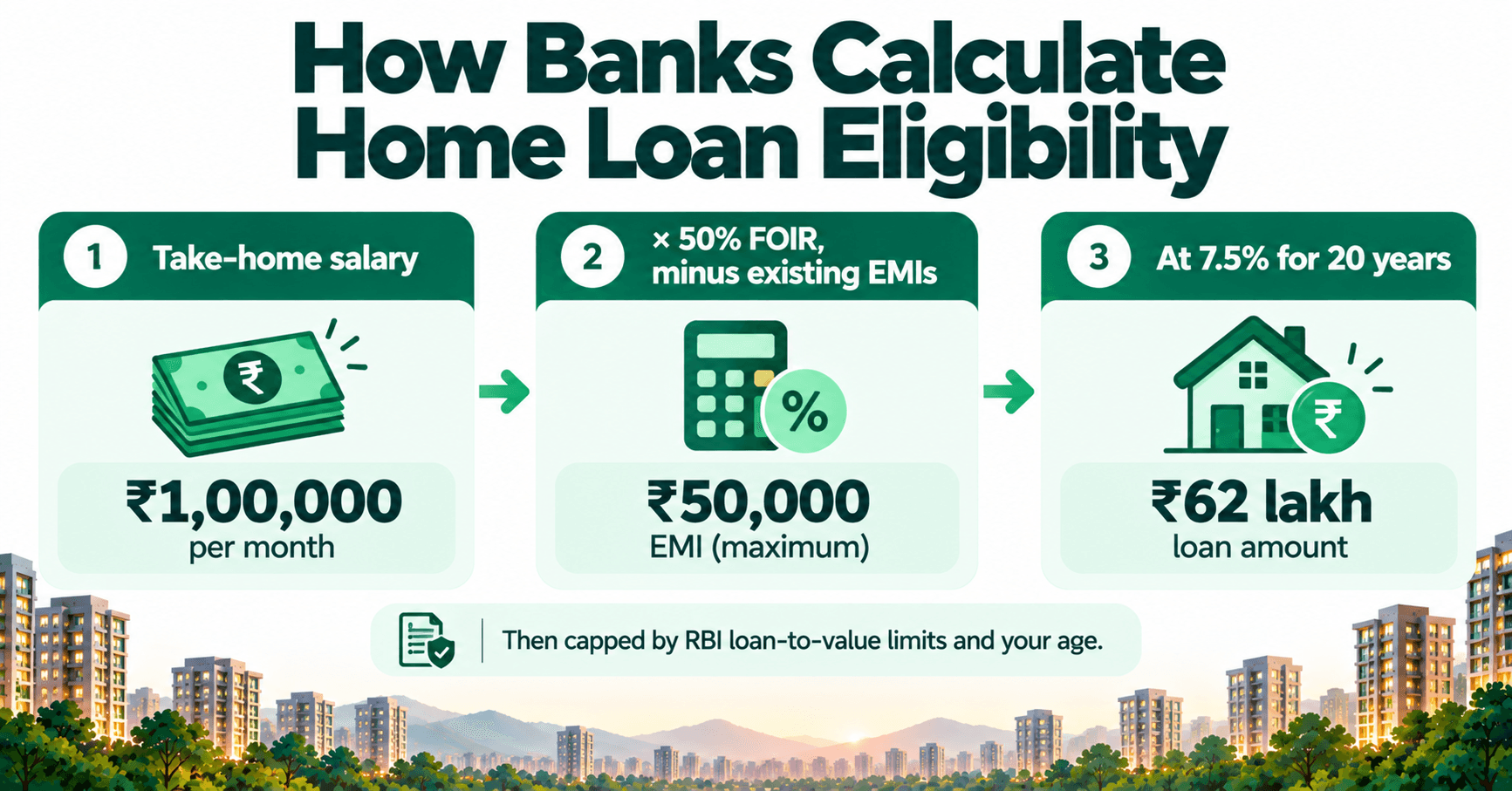
If you already pay a ₹15,000 car loan EMI, your room for a home loan EMI drops to ₹35,000, and your eligibility falls to about ₹43 lakh. That's why existing loans matter so much.
Home loan eligibility by salary: 2026 table
These figures assume 50% of your take-home pay goes to the home loan EMI and you have no other loans. Most strong applicants are being offered somewhere between 7.5% and 8% after the October hike.
| Net monthly salary | 7.5%, 20 years | 7.5%, 30 years | 8%, 20 years | 8%, 30 years |
|---|---|---|---|---|
| ₹50,000 | ₹31.0 lakh | ₹35.8 lakh | ₹29.9 lakh | ₹34.1 lakh |
| ₹75,000 | ₹46.5 lakh | ₹53.6 lakh | ₹44.8 lakh | ₹51.1 lakh |
| ₹1,00,000 | ₹62.1 lakh | ₹71.5 lakh | ₹59.8 lakh | ₹68.1 lakh |
| ₹1,50,000 | ₹93.1 lakh | ₹1.07 crore | ₹89.7 lakh | ₹1.02 crore |
| ₹2,00,000 | ₹1.24 crore | ₹1.43 crore | ₹1.20 crore | ₹1.36 crore |
Our calculation: maximum EMI = 50% of net monthly salary, monthly reducing balance. Your bank may allow a higher or lower FOIR, and the final loan also depends on the property's value.
Two limits sit on top of this. First, the loan can't be more than the RBI's Loan-to-Value cap: 90% of the flat's value for loans up to ₹30 lakh, 80% up to ₹75 lakh and 75% above that. Second, most banks want the loan repaid by the time you're 60 to 70, so a 45-year-old may not be offered 30 years.
Enter your salary, existing EMIs and age for an instant estimate, plus the property budget it supports.
Check My Loan EligibilityWhat this means in Pune: which flat can you afford?
Your budget for a flat is your loan plus your own money, minus the 7% or so you'll need for stamp duty and registration in Pune. Here's a rough guide, assuming a 20-year loan at 7.5% and the maximum the RBI's loan-to-value limits allow:
| Net monthly salary | Loan you can get | Flat price this supports | Typical in Pune |
|---|---|---|---|
| ₹75,000 | About ₹46 lakh | About ₹58 lakh | 1BHK or compact 2BHK in Punawale, Ravet, Wagholi |
| ₹1,00,000 | About ₹62 lakh | About ₹78 lakh | 2BHK in Hinjewadi Phase 2 or 3, Tathawade |
| ₹1,50,000 | About ₹93 lakh | About ₹1.24 crore | Larger 2BHK or 3BHK in Wakad, Kharadi |
| ₹2,00,000 (or two incomes) | About ₹1.24 crore | About ₹1.65 crore | 3BHK in Baner, Kharadi, Hinjewadi Phase 1 |
Flat price = loan ÷ 0.8 (or ÷ 0.75 above ₹75 lakh). You'll need the down payment plus about 7% for stamp duty and registration from your own savings. Localities are a rough guide based on 2026 registered prices.
How the October 2026 rate hike changed your eligibility
When rates go up, the same EMI pays off a smaller loan. The 0.25% hike, from 7.25% to 7.5% for a typical strong borrower, cut eligibility by about 1.9%. On a ₹1 lakh take-home salary, that's the difference between about ₹63.3 lakh and ₹62.1 lakh. It's a small change, but if you got a pre-approval in September at the old rate, ask your bank to confirm the amount again before you commit to a flat at the very top of your budget. Our Home Loan Interest Rates 2026 post has the full story on the hike.
8 ways to increase your home loan eligibility
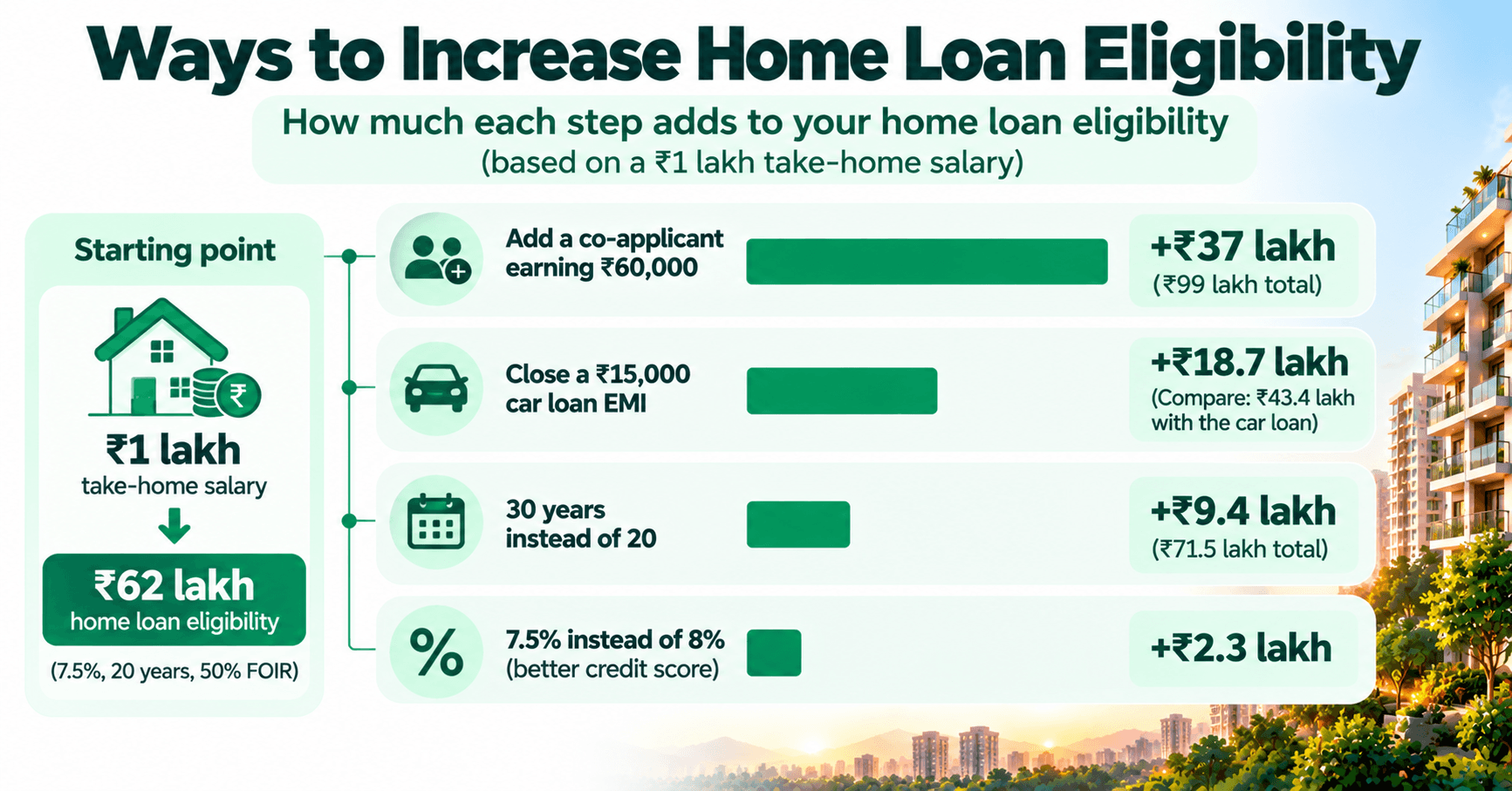
- Add a co-applicant with an income. A spouse or parent's income is added to yours. Two people taking home ₹1 lakh and ₹60,000 can borrow about ₹99 lakh together over 20 years, against ₹62 lakh alone.
- Choose a longer tenure. Going from 20 to 30 years raises eligibility by about 15%. You can always prepay later.
- Close small loans first. Paying off a ₹15,000-a-month car loan can add around ₹18 lakh to what you can borrow.
- Cut your credit card limits and balances. Some banks count a share of your card limit as an obligation even if you don't use it.
- Get your credit score above 750. It doesn't change FOIR directly, but it gets you a lower rate, and a lower rate means a bigger loan for the same EMI.
- Declare all your income. Rental income, regular bonuses and variable pay can be counted if they show up in your ITRs and bank statements.
- Pick a lender that suits your profile. Some banks allow a higher FOIR for higher earners or for employees of large companies. Compare at least three.
- Make a bigger down payment. It won't raise your eligibility, but it reduces the loan you need and keeps you within your limit.
Home loan eligibility for self-employed buyers
If you're self-employed, banks look at the income in your ITRs, usually an average of the last two or three years, rather than a salary slip. They'll also want to see that your business has been running for at least three years. Because declared business income is often lower than actual cash flow, self-employed buyers usually qualify for less than a salaried person with the same lifestyle. Filing ITRs that show your real income is the single biggest thing you can do to borrow more.
Don't borrow the maximum just because you can
Eligibility tells you what the bank will lend, not what's comfortable. Before you sign, check that you could still pay the EMI if rates rose another 0.5% to 1%, and that you'd have six months of EMIs and expenses saved for emergencies. With a ready-to-move flat, your rent stops as soon as you move in, which often frees up more of your income than people expect.
Check your numbers
Enter your own salary, existing EMIs and age in our home loan eligibility calculator to get an estimate in under a minute, along with the property budget it supports. Then use our EMI calculator to try different loan amounts, rates and tenures. If you're ready to start looking, browse our ready-to-move listings or talk to our team, and we'll connect you with lenders who can pre-approve your loan. Our Home Loan Checklist guide lists the documents you'll need.
All loan amounts in this post are our own calculations using the standard EMI formula. They're indicative only: your bank decides your actual eligibility using RBI guidelines and its own lending rules.
See how much you could borrow on your salary, in under a minute.
Open the Eligibility CalculatorFrequently asked questions
How much home loan can I get on a ₹50,000 salary?
With a take-home salary of ₹50,000 a month and no other loans, you can usually get about ₹31 lakh over 20 years or about ₹36 lakh over 30 years at 7.5% interest. That assumes your bank lets 50% of your income go to the EMI.
How much home loan can I get on a ₹1 lakh salary?
About ₹62 lakh over 20 years or ₹71.5 lakh over 30 years at 7.5%, if you have no other EMIs. Banks that allow a higher FOIR for your income level may offer more.
What is FOIR in a home loan?
FOIR stands for Fixed Obligations to Income Ratio. It's the share of your monthly take-home pay that can go towards all your EMIs, including the new home loan. Most banks set it at about 50% for salaried borrowers, and higher for bigger incomes.
Is home loan eligibility based on gross or net salary?
It varies by lender. Some ask for gross monthly income, while many banks assess FOIR on your net take-home pay after tax and deductions, as shown on your salary slip and bank statements. Regular bonuses or variable pay may be counted if they show up consistently in your payslips and ITRs.
Does a joint home loan increase eligibility?
Yes. The incomes of all co-applicants are added together, so a working spouse or parent can increase how much you can borrow significantly. Each co-applicant's existing EMIs and credit score are also checked.
What CIBIL score is needed for a home loan?
There's no fixed minimum, but 750 or above is generally considered strong and gets you the best rates. Below 650 to 700, many banks will offer a higher rate or a smaller loan, or ask for a co-applicant.
How much home loan can I get on a ₹50 lakh annual package?
Your monthly take-home depends on your tax and deductions, but roughly ₹3 lakh to ₹3.3 lakh a month. With 50% FOIR at 7.5% for 20 years, that's about ₹1.9 to ₹2 crore. Higher earners can often get a higher FOIR, so the figure may be more.
What is the maximum tenure for a home loan?
Usually 30 years, but most banks want the loan repaid by the time you turn 60 for salaried borrowers, or 65 to 70 for self-employed borrowers. So the maximum tenure you're offered depends on your age.
Did the October 2026 repo rate hike reduce home loan eligibility?
Slightly. A 0.25% higher rate reduces how much you can borrow for the same EMI by about 2%. On a ₹1 lakh take-home salary, eligibility over 20 years fell from about ₹63 lakh to about ₹62 lakh.
How can I increase my home loan eligibility quickly?
The fastest ways are adding an earning co-applicant, choosing a longer tenure and paying off small loans such as a car or personal loan before you apply. Lowering your credit card balances helps too.
Ready to find your next home?
Browse verified ready-to-move flats across Pune.