
Home Loan Checklist: Documents You Need to Buy a Ready-to-Move Flat
8 September 2026 · 12 min read · Updated 12 October 2026
Getting a home loan for a ready-to-move flat is usually simpler than for an under-construction one. The building is finished, the Occupancy Certificate is in place, and the bank normally releases the whole loan in one go instead of in stages. Even so, most delays we see come down to the same few things: a missing document, a down payment the bank can't trace, or a credit score nobody checked in advance. This guide walks through all of it. You'll find the documents to keep ready, how much of your own money you'll need, the charges banks add on top of the interest rate, a legal way to save on stamp duty, and a few ways to bring your rate down.
Quick summary
- Documents: ID and address proof, income proof (salary slips, Form 16 or ITRs, bank statements), and the flat's papers, especially the Occupancy Certificate for your wing.
- Down payment: usually 10% to 25% of the price, plus about 7% for stamp duty and registration in Pune.
- Hidden charges: processing fee, MODT, franking, CERSAI, legal and valuation fees. Ask for the Key Fact Statement.
- Stamp duty saving: about 1% less if the flat is registered only in a woman's name.
- Better rate: a credit score of 750 or more, a pre-sanction, and offers from at least 3 banks.
Identity and income documents
These tell the bank who you are and whether you can repay. Almost every lender asks for the same basic set.
- PAN card, Aadhaar or another photo ID, current address proof, and 3 or 4 passport-size photos.
- If you're salaried: your last 3 months' salary slips, Form 16 or ITRs for 2 to 3 years, and 6 months of bank statements showing your salary coming in.
- If you're self-employed: ITRs for 2 to 3 years with the income computation, proof of business (GST registration, shop licence or company documents), a CA-certified profit and loss statement and balance sheet, and 6 to 12 months of business and personal bank statements.
- Details of any loans or EMIs you're already paying. The bank uses these to work out how much more you can borrow.
Property documents
Missing property papers are the most common reason a simple purchase gets stuck.
- The sale agreement (or allotment letter, if you're the first buyer) and the full chain of ownership going back at least 12 to 13 years. Many banks prefer 30 years where it's available.
- The Occupancy Certificate for your wing and your flat. This is the most important document for a ready-to-move purchase, because big projects often get OC one building at a time.
- The society NOC, encumbrance certificate, approved building plan, commencement certificate and property tax receipts. For a resale flat, you'll also need the previous owner's loan closure letter if the flat was mortgaged.
How much down payment should you keep ready?
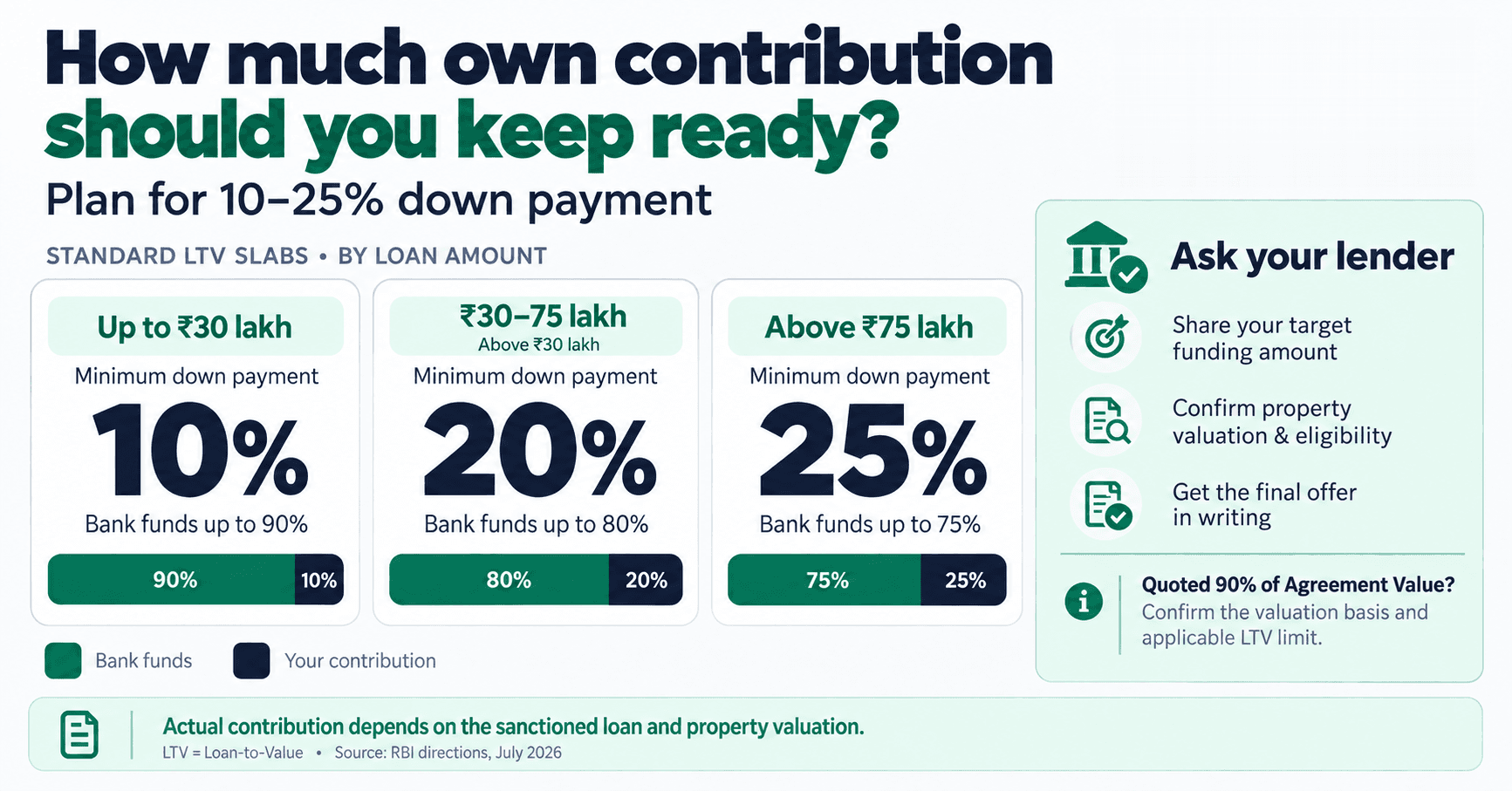
Banks don't lend the full value of a flat. Under RBI's Loan-to-Value (LTV) rules, they can fund up to 90% for loans up to ₹30 lakh, 80% for loans between ₹30 lakh and ₹75 lakh, and 75% above that. So your own contribution usually works out to 10% to 25% of the price. That said, some lenders will fund up to 90% of the agreement value even above ₹30 lakh, depending on the property and your profile. Don't assume the standard slab is all you'll get. Tell the bank how much funding you're looking for and let them tell you what they can actually offer.
- Budget for more than the down payment. Stamp duty and registration come to about 7% in Pune (6% if the flat is only in a woman's name), plus society charges, processing fees, moving and interiors.
- Keep the down payment money in your account for a few months before you apply. A big, sudden deposit just before a loan application gets questions.
- If part of it is a gift from family, keep a simple gift deed ready to show where the money came from.
- Borrowing more isn't free. Banks often charge a slightly higher rate on a higher-LTV loan, so a smaller loan with a bigger down payment can work out cheaper overall.
- Try a few loan amounts on our home loan calculator before you decide. Even a 0.25% to 0.5% difference in rate adds up to lakhs over 15 to 20 years.
- There's no single right answer. It comes down to how much cash you want to keep in hand versus how much interest you're happy to pay. Your financial adviser, or our team, can help you work it out.
All the charges to ask your bank about
The interest rate is only one part of the cost. RBI requires every lender to give you a Key Fact Statement that lists all the charges upfront. Ask for it before you sign anything.
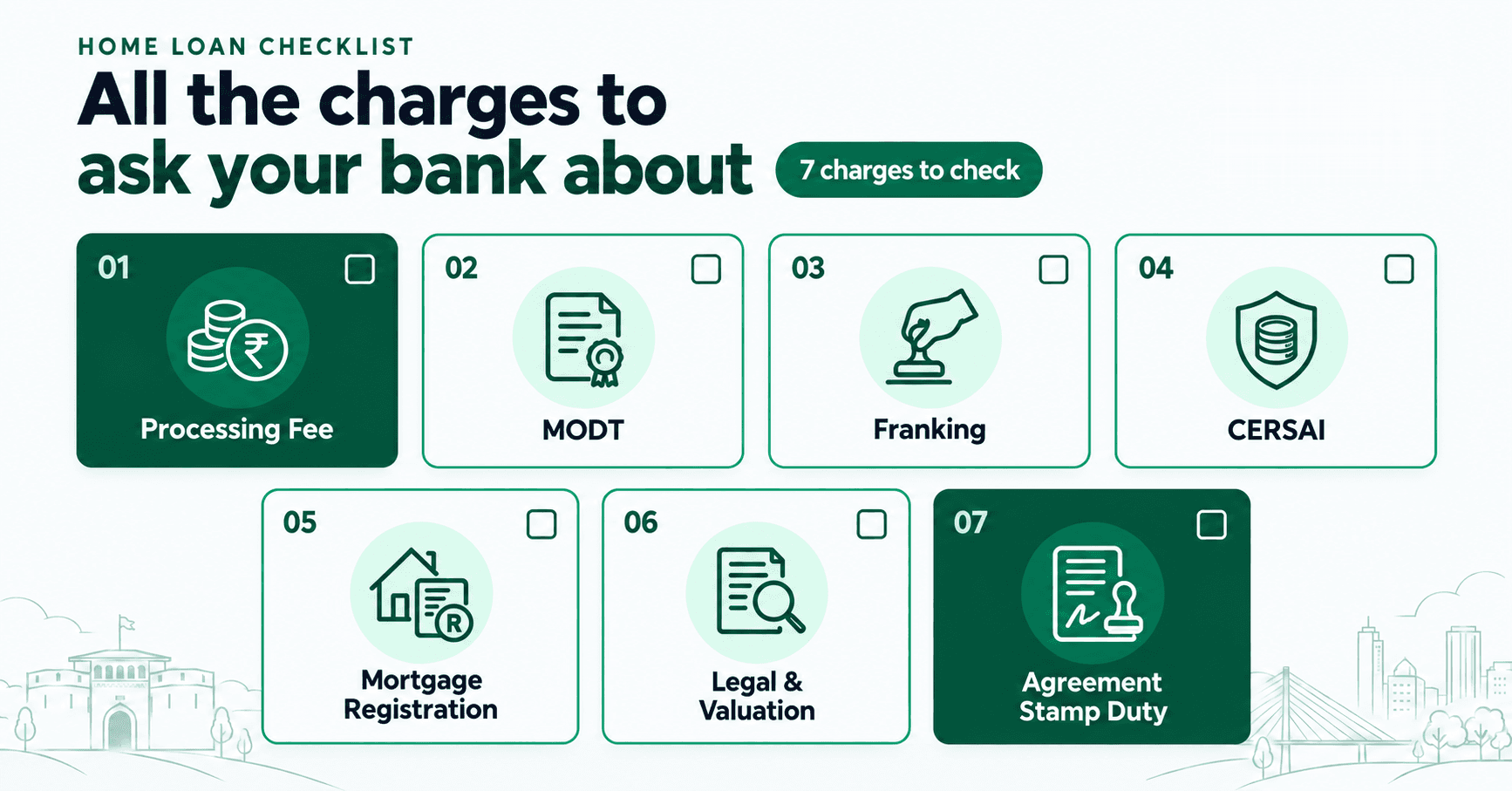
- Processing fee: usually 0.25% to 1% of the loan, sometimes capped at a flat amount for big loans. Ask whether you get it back if the loan doesn't go through.
- MODT (Memorandum of Deposit of Title Deed): handing your title deed to the bank as security is a legal step in Maharashtra, and it carries its own stamp duty, separate from what you paid on the purchase.
- Franking charges: the fee for stamping your loan documents, either at a franking centre or through the government's GRAS system.
- Mortgage registration charges, where they apply. These are separate from the registration fee on the flat itself.
- CERSAI fee: a small mandatory fee, around ₹50 to ₹100, that records the bank's charge on your flat so it can't be mortgaged twice.
- Legal and valuation fees for the bank's lawyer and valuer. Some banks include these in the processing fee and some bill them separately.
- Stamp duty on the loan agreement: a small charge, separate from the stamp duty on the flat.
Charges vary by lender and change from time to time. Check the current figures in your lender's Key Fact Statement.
Saving on stamp duty: putting the flat in your wife's name
Maharashtra gives a 1% stamp duty concession when a home is registered only in a woman's name. In Pune and PCMC that brings stamp duty down from 7% to 6%. On an ₹80 lakh flat, that's ₹80,000 saved just by how the title is written. Several 2026 reports say the old condition restricting resale to a man has also been dropped, but confirm the current rule with the sub-registrar before you register.
- This is about who owns the flat, not who takes the loan. The flat can be only in your wife's name while you're a co-applicant on the loan to boost the combined income.
- Ask your bank early. Some are fine lending on a flat owned only by the co-applicant. Others want every borrower on the title too.
- If you add both names to keep the bank happy, check with the sub-registrar how the concession works for joint ownership. Sources disagree on this, so don't assume.
What is a pre-sanctioned home loan, and why get one first?
Pre-sanction (also called pre-approval) means a bank checks your income, credit history and repayment capacity, and confirms how much it will lend you and at roughly what rate, before you've picked a flat. It's usually valid for 3 to 6 months, as long as the flat you choose clears the bank's legal and technical checks.
- You go house-hunting with a real budget instead of a guess.
- Sellers take you more seriously, which helps when you negotiate.
- Any income or credit problem shows up early, before you've paid a token amount.
- Final approval is quicker, because only the flat's papers are left to check.
Your credit score and why it matters
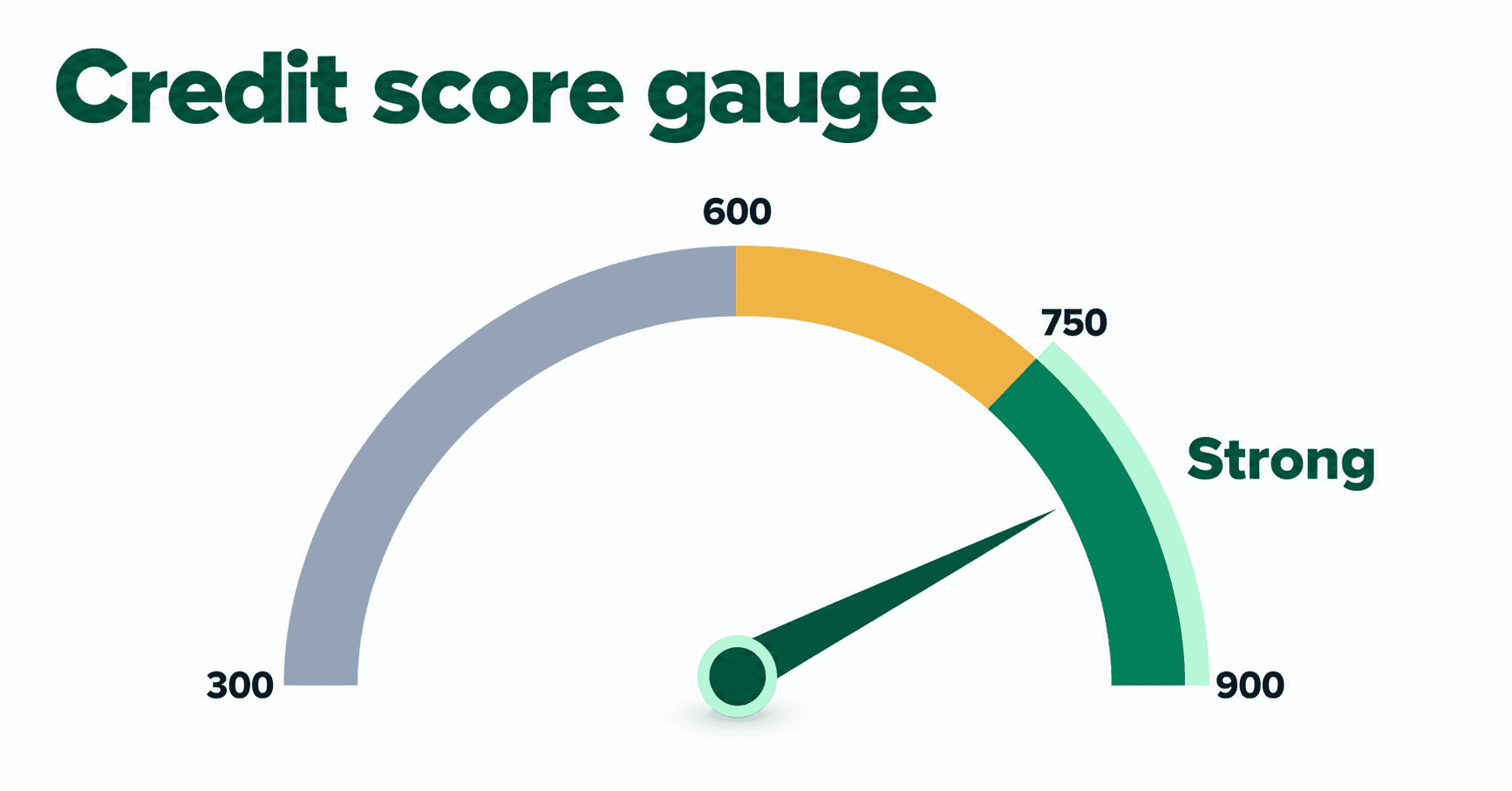
Your credit score (usually your CIBIL score) runs from 300 to 900 and shows how reliably you've repaid loans and cards in the past. Banks check it at the very start. A score of 750 or more is generally seen as strong, though every lender has its own cut-offs.
- A better score can get you a noticeably lower rate. A weak one can mean a higher rate, or a rejection.
- Pay every EMI and card bill on time. Even one missed payment can pull your score down for months.
- Use less than 30% of your credit card limit.
- Don't apply for new loans or cards in the months before your home loan.
- Don't apply to several banks yourself just to compare rates. Every formal application triggers a hard enquiry, and each one knocks your score down a little. A loan adviser who works with many banks can compare offers for you without that. Ask them to bring back offers from 3 banks so you can pick the best one.
- Check your score 2 to 3 months before you apply, so there's time to fix any mistakes.
We're not licensed credit advisers. Confirm current cut-offs with your bank.
Should you take insurance on your home loan?
Banks often bring this up at disbursement, and they tend to mix two different products into one pitch.
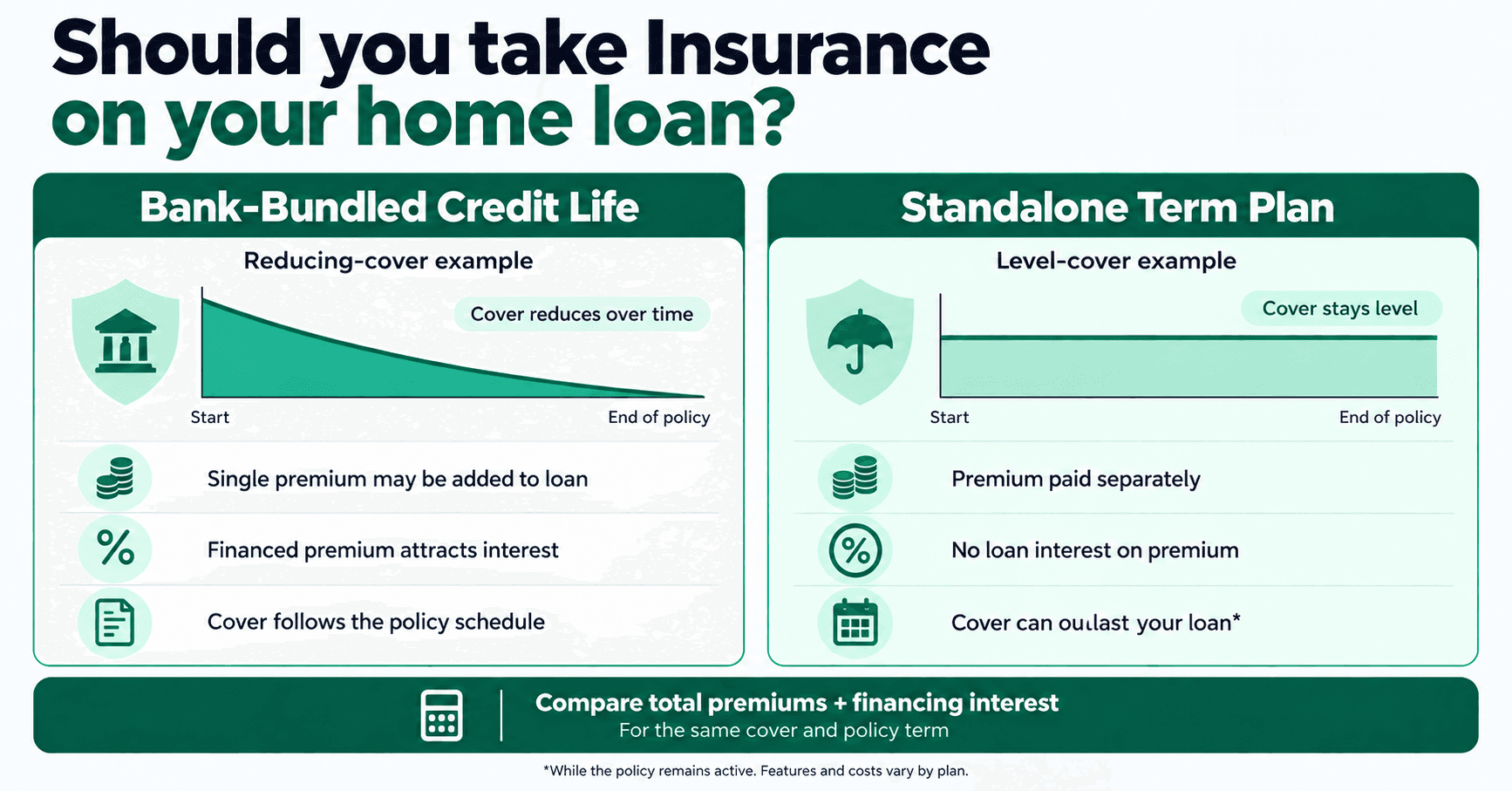
- Home loan protection (credit life) insurance pays off what you still owe if the borrower dies. It's useful, but RBI doesn't make it compulsory and a bank can't make it a condition of your loan. It's usually sold as a single premium added to your loan, which means you pay interest on the premium for years.
- A separate term insurance plan for the same amount is often cheaper over the life of the loan. It also keeps protecting your family after the loan is closed, while credit life cover shrinks as your loan balance goes down.
- Property or fire insurance is something else. It covers the building itself, and some banks do insist on it because the flat is their security. It's usually inexpensive.
- You can say no to a bundled credit life policy and buy your own term plan instead. If the bank says it's compulsory, ask them to show you where your sanction letter says so.
We're not licensed insurance advisers. Compare quotes and get professional advice before choosing your cover.
Other ways to lower your interest rate and fees
The first rate you're quoted is rarely the best one available. A few things worth trying:
- Compare lenders. Public sector banks, private banks and housing finance companies all price the same borrower differently, and 0.25% to 0.5% adds up to lakhs over 20 years.
- If a woman is the main applicant or a co-applicant, ask about the women borrowers' concession, which is often around 0.05%.
- A bigger down payment lowers your LTV, which can get you a better rate as well as a smaller loan.
- If you already have a loan at a high rate, look at a balance transfer. Just weigh the new bank's processing fee against what you'll save.
- Prepay when you have spare money. RBI doesn't allow banks to charge individuals a penalty for prepaying a floating-rate home loan.
- On the processing fee, ask about festive offers, discounts for salary-account holders or company tie-ups, and a flat-fee cap for big loans. A written quote from another bank helps. Negotiate the fee separately from any insurance they try to bundle in.
See exactly how much a lower rate saves you
After the RBI's repo rate hike on 7 October 2026, most banks raised their rates by 0.25%. As of late October, starting rates are about 7.25% at Bank of Maharashtra and 7.50% at SBI, while HDFC Bank starts at 8.00%. Our Home Loan Interest Rates 2026 post has the latest numbers. Small differences in rate turn into big amounts over 15 to 20 years. Put your own loan amount and rate into our calculator to see your EMI and how much you'd save at a lower rate.
Compare your current EMI with today's lowest rates and see how much interest you could save.
Open the Home Loan CalculatorTips to get your loan approved faster
Ready-to-move flats already get approved faster than under-construction ones. These habits speed things up even more.
- Have the bank's legal team check the flat's papers before you finalise the deal.
- Keep clearly named digital copies of every document above in one folder.
- Check your credit score and get a pre-sanction before you start shortlisting flats.
- Reply to the bank's questions the same day if you can. Unanswered queries cause most of the delays we see.
Browse verified listings
Every property on ReadyToMove is checked for clear paperwork, which usually makes the loan process smoother. Have a look at our current listings to get started.
Frequently asked questions
What documents are required for a home loan on a ready-to-move flat?
You'll need PAN, Aadhaar or another photo ID, address proof and photos; income proof (3 months' salary slips, Form 16 or 2 to 3 years of ITRs, and 6 months of bank statements); and the property papers, including the sale agreement, ownership chain, Occupancy Certificate, society NOC, encumbrance certificate and tax receipts. Self-employed buyers also need business proof and CA-certified financials.
Can I get a home loan for a flat without an Occupancy Certificate?
Usually not from a mainstream bank. Most banks won't lend on a completed flat without an OC, and those that sanction early often hold back the money until the OC is produced. In Maharashtra, it's also not legal to occupy a flat without an OC, so get the certificate checked before you pay anything.
How long does home loan approval take for a ready-to-move flat?
If your papers are in order, often 1 to 3 weeks. The bank's legal and technical checks on the flat typically take 5 to 10 working days, and the full loan is then paid out in one go at registration. A pre-sanctioned loan makes it quicker.
How much down payment do I need for a flat in Pune?
Usually 10% to 25% of the price, depending on the loan amount: 10% for loans up to ₹30 lakh, 20% between ₹30 lakh and ₹75 lakh, and 25% above that. Keep another 7% or so ready for stamp duty and registration, plus fees and moving costs.
Is GST charged on a ready-to-move flat?
No. A flat that already has its Occupancy Certificate doesn't attract GST. Under-construction flats carry 5% GST (1% for affordable housing). Stamp duty and registration still apply either way.
What is the stamp duty for women buyers in Pune?
About 6% if the flat is registered only in a woman's name, against about 7% otherwise. Registration is another 1%, capped at ₹30,000. Check the current rate with the sub-registrar before you register, especially for joint ownership.
Can the property be in my wife's name while I'm the main loan applicant?
Yes. Owning the flat and taking the loan are separate things. It's common for the flat to be only in the wife's name for the stamp duty saving, with the husband as a co-applicant on the loan. Check early that your bank is comfortable with this.
What credit score do I need for a home loan?
There's no fixed cut-off, but 750 or more is generally seen as strong and gets better rates. You can still get a loan with a lower score, usually at a higher rate or with a stronger co-applicant.
Does applying to many banks hurt my CIBIL score?
Yes, a little each time. Every formal application leads to a hard enquiry on your credit report. Instead of applying everywhere yourself, use a loan adviser who can compare offers from several banks for you.
What is MODT and why is it charged separately?
MODT stands for Memorandum of Deposit of Title Deed. When you hand your title deed to the bank as security, that's a separate legal step in Maharashtra with its own stamp duty, on top of what you paid on the purchase. Ask your bank to show it as its own line item.
Is home loan insurance compulsory?
No. RBI doesn't require credit life insurance and a bank can't make it a condition of your loan. Property or fire insurance is different, and some banks do ask for it because it protects the flat they're lending against.
Ready to find your next home?
Browse verified ready-to-move flats across Pune.